LinkedIn articles are having a little “resurgence” moment.
And it’s been a while. I’ve been posting on LinkedIn for 5+ years, and not once has that ever happened. There was no point to them, really, since you could start a blog or an email newsletter instead and get 10x the value out of either.
But the research is undeniable.
In early 2026, SEMrush analyzed 325,000 unique prompts across ChatGPT, Google AI Mode, and Perplexity. They found 89,000 LinkedIn URLs cited in AI-generated responses. LinkedIn came in as the second most cited domain across all three platforms, appearing in 11% of AI responses on average, ahead of Wikipedia, YouTube, and every major news publisher.
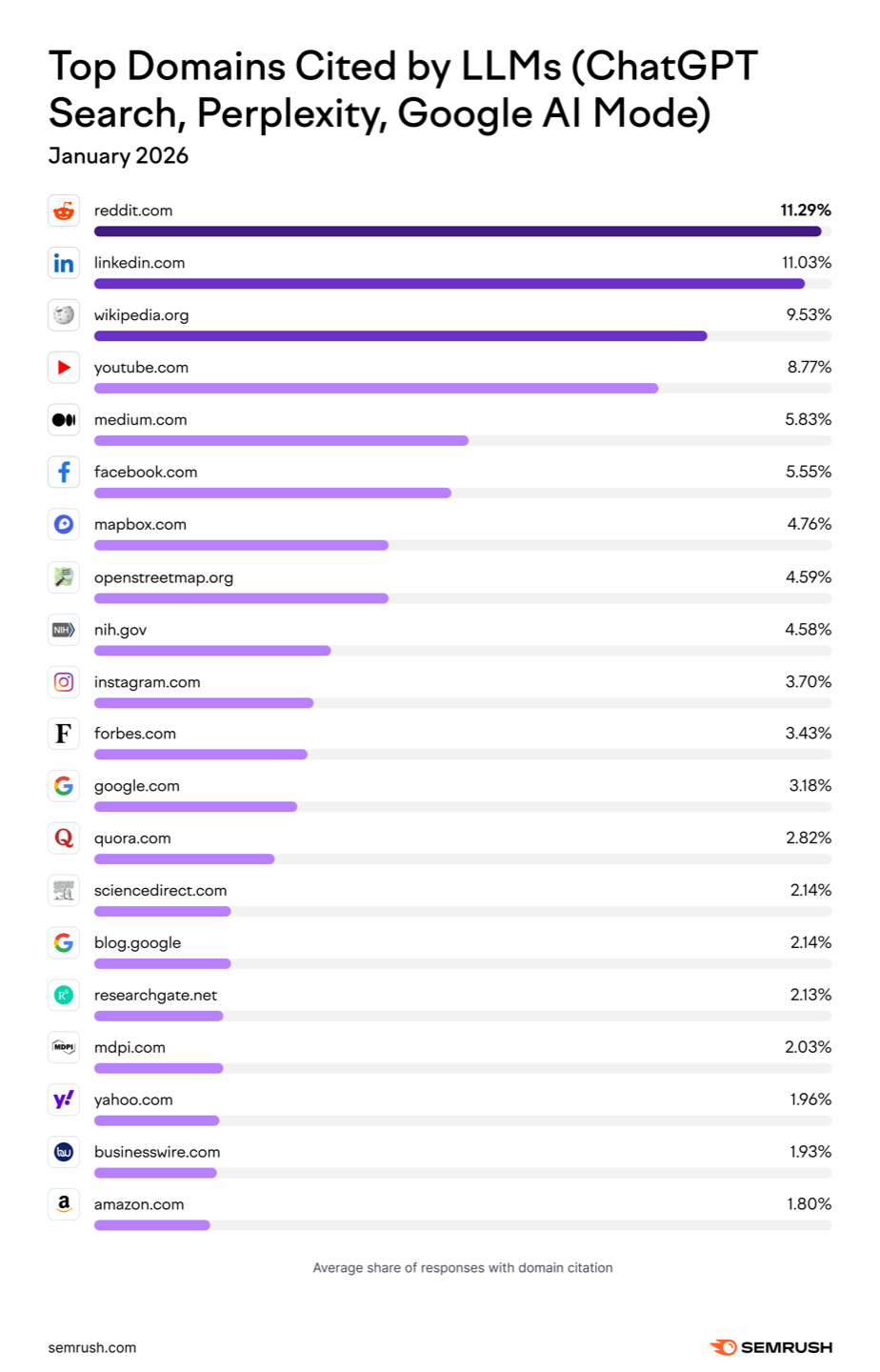
For professional queries specifically?
LinkedIn is #1. Across every major AI platform.
Jason Vana, THE sharpest brand strategist I know, put it plainly when he started writing articles himself a few weeks ago: LinkedIn has become one of the most cited sites in LLMs, and it’s not your regular posts doing the work.
It’s articles. Structured, headlined, SEO-optimized content.
The DOJO newsletter confirmed the same with their own research: “Your company page posts aren’t getting cited by AI. Your people’s posts are.” And of those, articles dominate.
Between November 2025 and February 2026, LinkedIn climbed from approximately #11 to #5 among domains cited by ChatGPT. Profound, which tracks 1.4 million citations across six AI models, called it the largest domain authority shift they’d observed all year.
A second, independent dataset lands on the same rank. Meltwater’s May 2026 study analyzed 9.5 million citations across six AI models, including Claude and Copilot: LinkedIn again came in second overall, growing 26% inside a single tracking window, and ranked as a top-5 source in 14 B2B categories.
Well, the game is on.
But why should you, as a climate founder, write LinkedIn articles in 2026?
When an investor runs a prompt in ChatGPT to research the landscape in atmospheric water generation, or sustainable packaging, or grid-scale battery storage, the results pulling through are LinkedIn articles tied to individual profiles. Company pages and press releases sit much further down.
On ChatGPT and Google AI Mode, 59% of cited LinkedIn content comes from individual creators. Your company page is much less likely to be cited than your personal profile.
Your buyers and investors are increasingly starting their research in AI tools, well before they open Google. I personally search everything with Perplexity instead of Google.
Publishing articles puts you in those answers. Staying quiet hands that ground to someone else in your vertical.
Do you need a big following to get cited by AI?
No. In Meltwater’s dataset, 51% of the creators AI engines cited had fewer than 10,000 followers, and accounts in the 1,000–10,000 range contributed the largest share of citations. SEMrush found the median cited post had 15 to 25 reactions and about one comment.
The engines are selecting for structure and specificity. Audience size barely registers. For a climate founder starting from zero, that is the whole opportunity: the reach game takes years, the citation game starts with your first well-built article.
LinkedIn articles vs posts: which gets cited by AI?
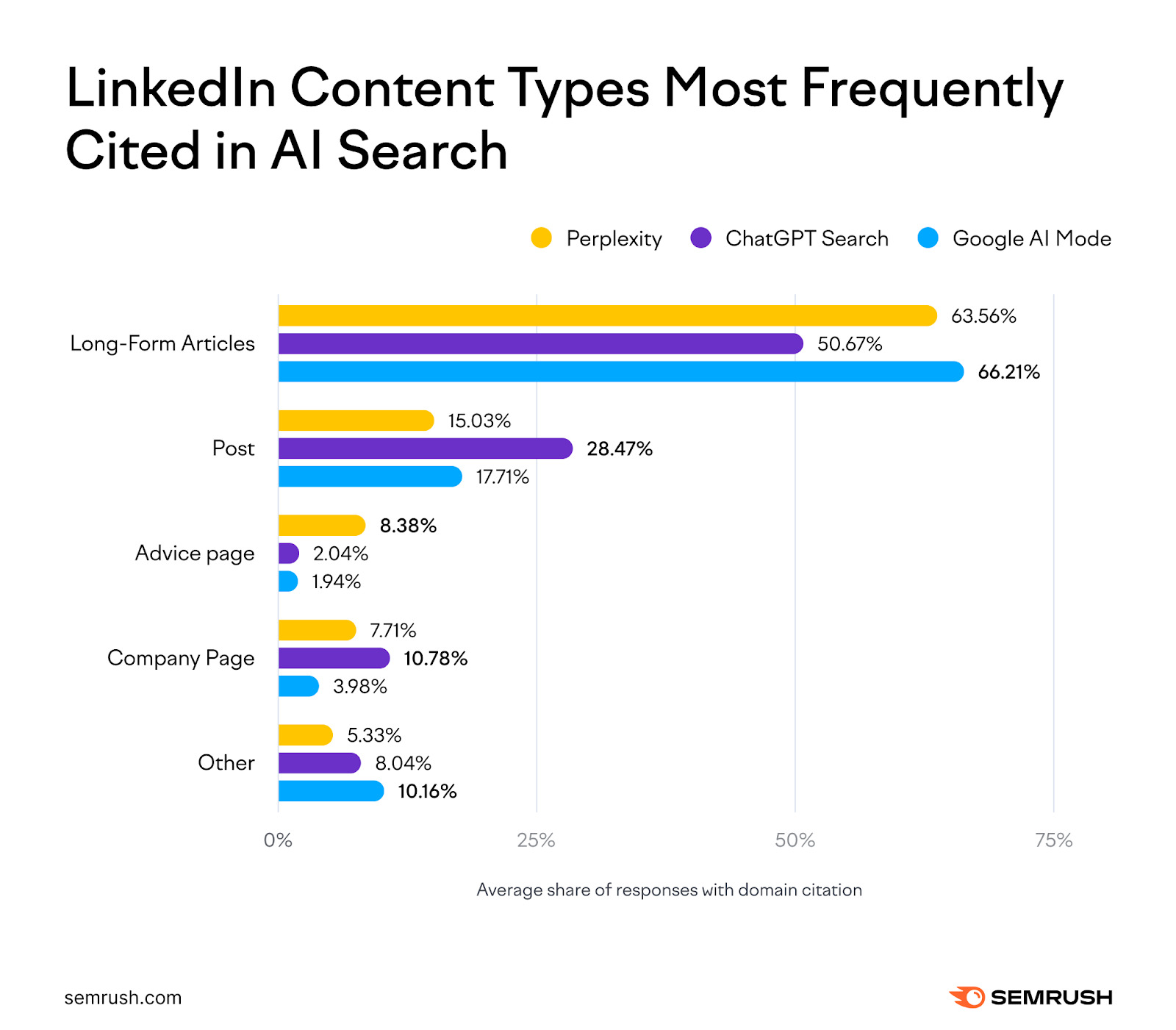
The two big studies split on this, and the split is worth understanding. SEMrush’s March 2026 analysis put articles at 50–66% of LinkedIn’s AI citations. Meltwater’s broader May 2026 study found text posts carrying 72% and articles 12%.
Two things are true at once. Posts win on volume, and articles punch far above their share of what gets published: Social Media Today reports AI citations of LinkedIn articles grew up to 5x year over year, and roughly 15,000 of the 19,202 LinkedIn sources in one analysis were Pulse articles. Write both. Posts earn the reach, articles build the library AI keeps going back to.
And I hear you ask, “Cool, Roman, where do I start?”
Glad you asked.
7 tips to write your first LinkedIn article as a climate tech founder
Note: I’ve pulled the research on this from across LinkedIn and studied the top thought leaders like Jason Vana practicing this in public. This list might evolve as I start testing them as well.
Tip 1: Find your article topic using your existing content or AI search gaps
Two paths here, depending on where you’re starting from.
If you’ve never published organic content or written a single blog or newsletter: Open ChatGPT or Perplexity and type the question your ideal investor or buyer would ask.
Something like:
“How do atmospheric water generation startups approach B2B sales?”
“What should I know before investing in green hydrogen at Series A?”
“How do I reduce Scope 3 emissions in our supply chain?”
If the response pulls no strong LinkedIn sources, or pulls ones that belong to someone else in your vertical, that’s your gap. Write the article that should exist.
If you already post on LinkedIn: Start with your top 3 posts from the last 6 months. The one that got the most comments, reactions or DMs, that’s your article. It already proved the idea resonates. Now go 5x deeper on it.
Expand on it by sharing more: more tips, more examples, more mistakes to avoid, more reasons why, etc.
For example:
LinkedIn post: posting a 250-word take on why carbon credit markets are broken.
LinkedIn article: writing a 900-word article titled “Why Carbon Credit Markets Keep Failing Climate Startups and What Needs to Change” built from that same post and the 12 comments it generated.
Tip 2: Write your headline as a search query
AI systems and humans searching on LinkedIn both need to understand what your article is about from the headline alone. If your headline is clever, it’s probably not specific enough.
Clever: “The Future of Clean Energy Is Here”
Clear: “7 Diversification Strategies For US Solar Installers To Generate More Recurring Revenue in 2026”
Include your niche, a specific outcome, and, where relevant, the year. Timely, specific headlines signal to AI that this content is current and authoritative.
Tip 3: Structure each section so AI can extract a direct answer from it
AI scans your article for extractable chunks: a clear question, a direct answer, supporting context. A vague heading followed by three sentences of scene-setting gives it nothing to work with.
Use H2 headings that complete a full idea or answer a real question. Open each section with the direct answer first, then explain.
Before:
H2: Green hydrogen and the energy transition
“Green hydrogen is an exciting technology. There are many discussions happening in the industry. Some experts are optimistic. Others point to the infrastructure challenges ahead...”
After:
H2: Why green hydrogen offtake deals keep stalling at Series A
“Most green hydrogen offtake contracts collapse before signing because industrial buyers need 10-year price certainty and early-stage founders can’t offer it. The deals that close use a different structure: milestone-linked pricing with a floor guarantee.”
The second version opens with a direct, citable claim. AI can extract it, attribute it to you, and surface it when an investor searches “green hydrogen challenges Series A.” The first requires AI to infer what the section is even claiming, which means it won’t cite it at all.
Meltwater’s teardown of top-cited articles backs this up: 100% of them used bullets or lists, 92% used headings, and 67% carried hard numbers. SEMrush adds a length band, 500 to 2,000 words, and notes 75% of cited authors publish five or more times a month.
Tip 4: Write from your specific experience
LinkedIn’s own data found that 95% of AI citations come from original content. Reshares account for 5%.
Generic industry commentary doesn’t get cited. Specific, first-person insight does.
Generic take: “Green hydrogen has massive potential in Europe as energy policy shifts.”
Specific take: “We piloted green hydrogen offtake contracts with 3 industrial buyers in the Nordics in 2024. Here’s what we learned about pricing, timeline expectations, and why two of the deals almost fell apart.”
The second version has a point of view, a context, and a claim AI can attribute to you as an expert. The first reads like a press briefing. Any analyst could have written it on a slow Tuesday.
Tip 5: Keep it between 800 and 1,200 words
LinkedIn’s own internal testing confirms this is the range that performs best for AI discoverability. Long enough to be substantive, short enough to stay focused and extractable.
Tip 6: Make sure your profile and article topics say the same thing
LLMs read your article and check who wrote it in the same pass. If your LinkedIn headline says “Co-founder at CorPower Ocean” but your article is a generic take on leadership with zero mention of wave energy, AI registers a mismatch and weighs the citation down.
Your headline, About section, and article themes need to align. If you’re a climate tech founder building in sustainable packaging, your articles should consistently cover sustainable packaging: the market, the technology, the problems you’re solving.
That consistency is how AI learns to associate your name with your topic.
(Pro tip: look at these ‘AI’ tools as not AI, but more advanced pattern recognition algorithms. That’s all there is to it.)
Tip 7: Post at least one article per month, consistently
SEMrush found that most cited LinkedIn posts had only 15–25 reactions. Not viral. What those authors shared was a posting cadence, not a breakout moment.
One well-structured article per month, tied to your niche, keeps building in a way four sporadic posts never will. The algorithm forgets. AI indexes and holds.
The gold rush of LinkedIn articles is upon us
Climate tech doesn’t have enough great content. I’ve said it for years.
There are brilliant founders solving genuinely hard problems (desalination, grid storage, alternative proteins, carbon removal) and most of them are either silent on LinkedIn or only posting company updates that disappear in 48 hours.
The founders who start writing articles now are the ones AI will cite in 6 months when an investor asks “who should I follow in [your vertical]?”

That could be you.
I hope this article was helpful.
Cheerio!
Whenever you’re ready, there are 3 ways I can help:
1/ Get a copy of my book → It’s called From Invisible to Investable: The 7 Stories Every Climate Tech Founder Should Tell Online to Get Backed, Booked, and Believed In. Perfect if you’ve never shared stories online before.
2/ Use my Climate Tech Post Vault → these are my 55 most reused LinkedIn post templates that generated 13,321 reactions, 2,187 comments, 999,365 impressions across all of my work.
3/ Buy your In-House Ghostwriting OS → An all-in-one system for solo marketers and small marketing teams in climate tech companies to create, launch, and grow a system for building their CEO’s personal brand on LinkedIn.