Last year, a climate tech founder gave one of the better podcast interviews I’ve heard. Sharp, funny, honest about the genuinely hard problem he’s spent years on: growing real salmon from cells, then getting it onto plates at the price of the wild-caught kind.
Then the episode dropped, he reshared the link once, and went quiet.
Last week I wrote about what that cost him: the listeners who came looking and found nothing.
This is the other half: the window where you can still catch those listeners. It’s short. 72 hours, give or take.
And it’s not only the never-posted founders who miss it. Founders who post every week miss it too. The episode airs, they share the link, they move on. Finish line crossed.
The episode going live isn’t the finish line. It’s the starting gun.
The attention from an interview fades in about three days.
When your episode goes live, people listen, get curious, and go looking for you.
Within a few days, that stops. The host’s audience moves on to the next episode. The strangers stop arriving.
So you get a window. Call it 72 hours from the day the episode drops. Not the day you record. The day it goes live.
(72 is a practitioner number, not published research. The platforms bracket it: Transistor counts a show’s subscribers by who downloads in the first 24 hours, and Buzzsprout scores every episode by its first 7 days. The window sits in between.)
Inside the window, people who just heard you talk for 45 minutes are searching your name. After it, you’re back to posting for the same people who already follow you.
What you do in those three days decides whether the interview keeps bringing you people or ends as one pleasant conversation.
Resharing the link feels like enough. It isn’t.
You post the link. “Great conversation, have a listen.” It feels productive.
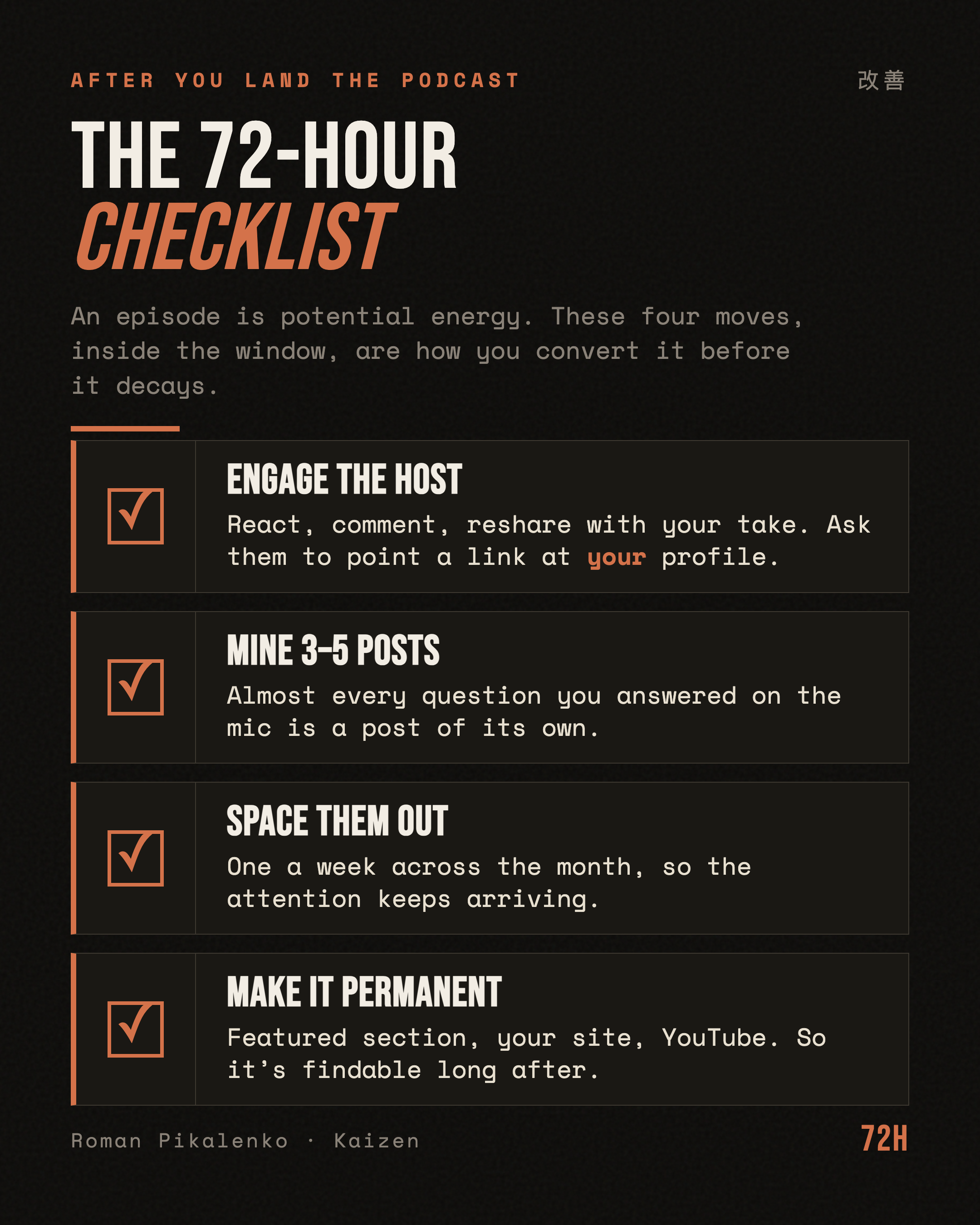
But follow the click. It lands on the host’s page. Their subscriber count grows. Their next episode gets easier to sell. You talked for an hour, and the host kept the audience.
To be fair: do thank the host. Share their post, cheer the episode. That’s how you get invited back. Just don’t let it be the only thing you do.
The point of the hour was to turn some of their listeners into your followers.
The algorithm stacks against the link reshare too. AuthoredUp’s analysis of 500,000+ posts found posts with external links earn roughly 3.5x fewer reactions, and a 900,000-post study measured no-link posts winning about 50% more impressions, a gap that has widened every year since 2023. LinkedIn’s own team denies a link penalty exists. The numbers keep disagreeing.
The window has one job: give the curious listener somewhere to land.
The person who finishes your episode wants more of you. For about three days, they’ll actually go looking.
What they find decides everything. If they land on a profile with your thinking on it, they follow you. From then on, you can reach them every week without needing another invite. If they land on a feed of reshares, they leave. The hour on the mic bought you nothing.
I watch the good version of this up close. Brian Sheng, the founder of Aquaria, has done more than 20 podcasts in the two years I’ve worked with him. Whenever we’re low on post ideas or want video on his feed, we reuse one of those interviews. Every time, the hosts show up in the comments again, and new people go find the older episodes.
That only works because his feed is alive. Every reuse has somewhere to land. His interviews never stopped working, and some of them are years old.
If you’ve never posted, the interview is your deadline.
The hardest part of posting is the blank page. What could you possibly say that anyone would want to read?
An interview solves that. Someone spent an hour asking you good questions, and you answered out loud, in your own words. The material now exists.
One catch. Remember the founder at the top: curious listeners need somewhere to land. If they arrive and find nothing of yours, they turn around and leave. So the window only works if something’s waiting when the episode drops. Even a handful of posts.
That’s why a booked podcast is a deadline. Treat it like one.
“I’ll deal with it after the launch.”
You won’t.
The window will close, the next fire will start, and the episode will sink to the bottom of a feed nobody scrolls. This keeps happening to good founders, and it isn’t laziness. The interview feels like the achievement, so the work feels finished.
And yes, the recording keeps. You can reuse it a month later, and you should. But the strangers searching your name this week won’t come back next month.
The only fix I’ve seen work: decide what your three days look like before the episode airs, while you’re still excited about it.
How to check what a podcast appearance earned you
Two 5-minute checks.
First, find the last time someone put you in front of their audience. A podcast, a panel, a webinar, the article about your round. Open your LinkedIn activity from the 72 hours after it went live. Count the posts that pointed people to you instead of the host. For many founders the count is zero. Good news: it’s also the easiest number to change.
Second, nothing to look up yet? Then you get to run this before it costs you anything. Finish this sentence: “When my first episode drops, a curious listener will find ___ of mine.” If you can’t fill the blank, that’s the gap to close before the invite lands. Not after.
And a small exception to my no-checklist rule: the whole window on one page. Save it for your next episode.