One of the most underrated ways to know if your post is ‘authentic’ is a simple test.
Could a competitor copy-paste it onto their own page, and it would still work just as well?
It’s a whole rabbit hole I tend to go into, so I decided to write an in-depth piece on it. Let’s get cracking.
Why does so much climate tech content look like everyone else’s?
Because anyone can steal it.
Most of the content that works really well on social media is either the latest fundraising round recaps, or reposting the same viral, tech videos. It’s a trend I’ve been seeing on LinkedIn quite a lot. And it’s incredibly annoying, because none of it is original.
If you’re sharing a list of “here are all the climate tech companies that raised money last week,” someone can steal it and claim as their own ‘takeaways’. Literally.
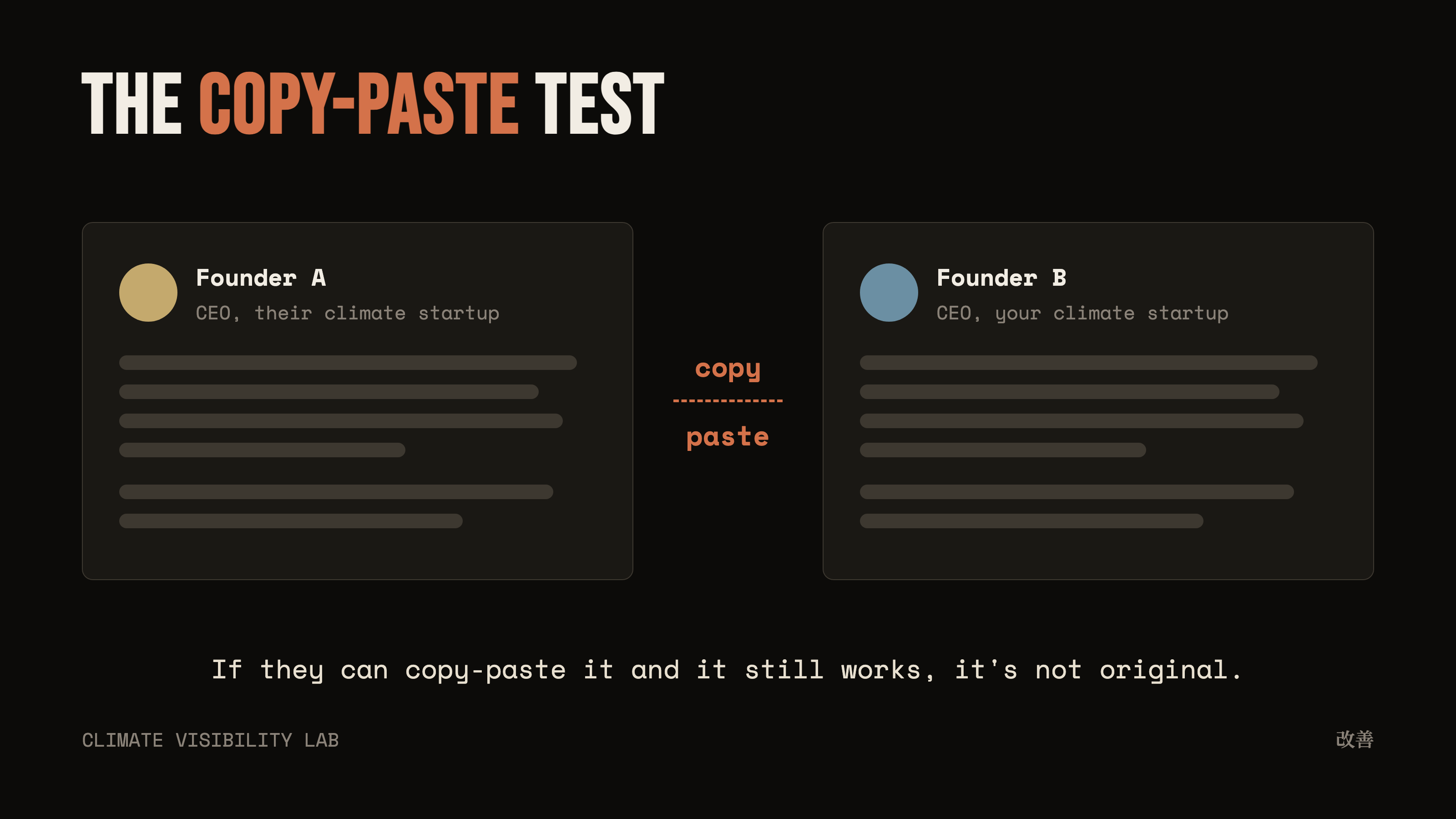
I call it the Copy-Paste Test: if someone copy-pastes your post to their own LinkedIn and it still works, it’s not original.
And it’s a thing to be mindful of, because if it’s not original, I, or any of your readers, have no reasons to trust you. To them, you’re just a news outlet. They don’t give a sh*t about you or what your company does or what your business does.
(If you think that’s harsh, welcome to the internet)
Any AI tool out there can generate a list of the latest fundraises. That doesn’t tell your reader anything about why they should care about YOU. And it doesn’t even work as a growth hack: Semrush analyzed 20,000 keywords in 2026 and found human-written content takes the #1 spot on Google 80% of the time, against 9% for AI-only content.
And at the end of the day, if that’s how you want to play it, when your buyers are comparing vendors, they’ll simply go for a cheaper option, or someone louder than you with worse tech simply because there’s nothing to remember you for.
These are the market dynamics of modern entrepreneurship. If you refuse to play by those rules, unfortunately, you’re gonna join the growing statistic of struggling startups.
And climate tech startups fail a lot. When the MIT Energy Initiative went through the cleantech companies funded between 2007 and 2011, over 90% never returned even the capital invested. The money side of that story is well documented. The visibility side is the one I keep watching founders repeat: they stay silent, and when they finally invest in marketing, they fall into the same slop trap, whether it’s AI slop or repetition slop from all those LinkedIn gurus.
Why does climate tech long-form read like a research paper?
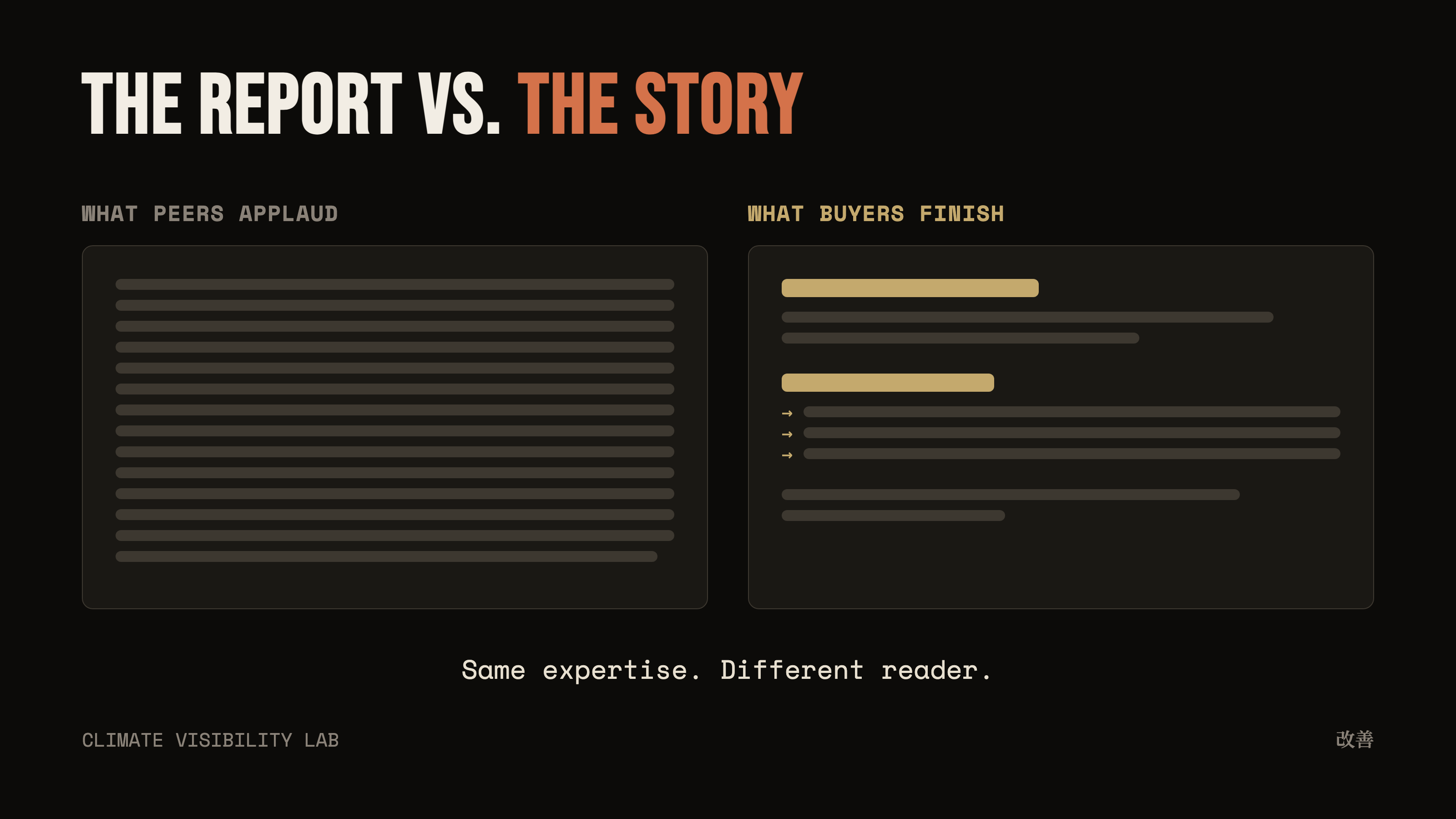
Because it’s written for peers, not for buyers. The second issue shows up most often in longer-form content.
It tends to be incredibly long, report-style, super technical, full of jargon, and formatted for your eyes to lose track of what you just read.
Whenever I read something like that, I’m under the impression the author has no idea who the target reader is. Because if you’re talking to a potential buyer, a 3,000-word report full of findings is not going to convince them you’re the solution.
Two examples, pulled straight from my own Substack feed:
Whereas the first-order impacts of global warming and climate change include many readily appreciable consequences, like extreme heat and sea level rise, the complexity of Earth’s climate systems and how subcomponents of it interact with one another also gives rise to second and third order impacts and risks, some of which could be even more catastrophic. An example of such risks are tipping points, which are thresholds beyond which components of Earth’s climate systems are at risk of entering irreversible transitions to new, significantly altered states of equilibrium and function.
Almost half of companies reported against at least eight of CDP’s 23 transition plan indicators, and financial planning disclosure rose from 5% in 2023 to 17% in 2025. However, fewer than 1% of all disclosures met CDP’s full credibility threshold. Supply chain engagement remains an area of weakness, despite its importance to economy-wide decarbonization.
Both are technically brilliant pieces, but the level of complexity surrounding the main idea raises the bar to what kinds of readers get attracted AND retained. In plain English: not everyone is a smart-pants like you.
(Mind you, neither of these came from a founder. In climate tech, the long-form gets written by analysts and journalists most of the time, while the founders themselves are nowhere to be found.)
Writing like that will show a buyer you know your industry well enough. But it’s not convincing. You know what’s convincing? Addressing the problems your target customer has. Explaining why their current way of doing things is poor, and what it’ll lead to if they don’t fix it.
Then explaining what your solution is and why it fits so well. The best way to do it is through storytelling. I’m even writing a book on the subject (!!!).
And if you just throw a bunch of jargon and complicated report language at the reader, and make it so insanely unscannable (meaning you don’t even format it, it’s just chunky text), you’ll scare off the right readers and only attract peers who will never invest in your business. Substack publications suffer from this greatly.
Jargon has a price tag too. Aha Media showed 150+ B2B decision-makers two versions of the same company description in 2024, one jargon-heavy and one plain. 80% preferred the plain one. And 73% wanted a demo after reading it, versus 44% after the jargon version.
If that’s your content, your engagement might be good. But you’ll end up attracting your peers: researchers, competitors, companies solving the same problem. You’ll never turn that reader into a partner or an investor.
And speaking of investors, the majority of your investors don’t have your domain expertise. If you’re a battery manufacturer and you have a great new idea on how to make batteries more energy efficient, chances are 90 to 95 percent of your investors don’t have a background in battery manufacturing.
All they care about is that you can communicate clearly who you are, what problem you solve, why they should care, and in what unique way you do that (and the ROI for them, of course). That requires plain language. Potentially shorter language. And something memorable, which storytelling does better than anything out there.
That’s the whole reason I’m writing my book.
Because honestly, this is so tiring. There are so many climate tech companies out there that are great at what they do, and absolutely terrible at communicating their value in an engaging way.
Yes, you’re scientists. But you’re people first. You’re creating amazing tech, and you have personalities. Show them.
How do you make your writing more original?
Two ways, and both are simple.
Number one: always be very specific about who you’re writing to. Describe their experience. Are they beginner, advanced, or somewhere in between? Describe their background: title, company type, and what problems they’re looking to solve.
If your content piece doesn’t help solve that problem, it’s arguably useless.
For example, this piece is addressed at Series A+ climate tech founders who have never posted online and are hesitant about starting, because they see so much slop out there and they’re unsure what good looks like. So I wanted to tell you what good definitely DOESN’T look like.
Number two: focus on the emotion you’re trying to evoke. Human beings are emotional beings. I don’t care whether you have a PhD. You get emotional and frustrated whenever your pilot doesn’t work out, or your model isn’t acting the way you calculated, or, simply put, you’re on a caffeine crash and people are pissing you off in the middle of the day.
That’s a normal human thing to do.
There are eight basic emotions you can tap into: joy, trust, fear, surprise, sadness, disgust, anger, and anticipation. The ones I’d write toward in climate tech: anger, excitement, relatability, and awe. Someone in awe has that exciting, mesmerizing kind of feeling. Pick one and write with it in mind. Because if you read the draft back yourself at the end and you don’t feel angry, pissed off, mesmerized, or excited, this is not something you should publish.
But isn’t “original” easier said than done?
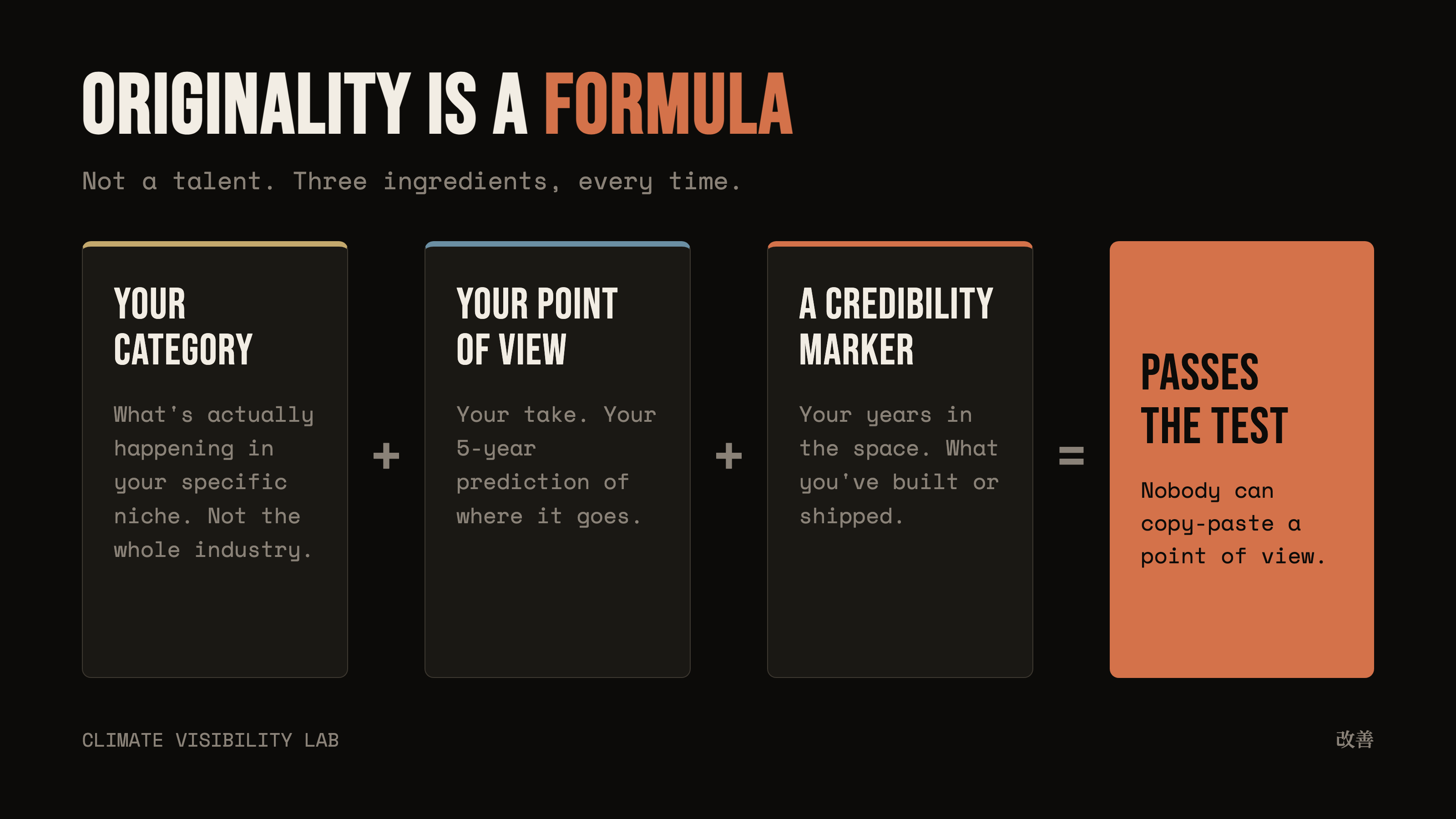
Common concern. But there’s an actual formula I’ve developed over the years.
- Take what’s genuinely relevant and happening in your specific category, not in the whole industry.
- Combine it with your own expertise and point of view.
- Then add a credibility marker: how long you’ve been in the space, or what you’ve built there.
Say your category is sustainable construction materials. (An active niche, and not a client of mine. Just an example.) Instead of reporting “climate tech raised $X this week,” cover the actual research happening in low-carbon cement. Cover the discussions worth having in that niche. Then add a genuine point of view: your own 5-year prediction on where it’s headed.
Or say you’re in direct air capture. The generic version is “carbon removal raised $X this week.” The formula version starts with what actually happened in your category: Climeworks closed $162 million in July 2025, pushing its total funding past $1 billion, with the money going into doubling the energy efficiency of its capture units. Anyone in your niche could dig that up.
Your point of view is the part they can’t dig up. Where do you think cost per ton lands by 2030, and why? And if you’ve spent three years modeling capture economics yourself, say so in the same post. That’s your credibility marker, sitting right next to the opinion it backs.
Nobody can copy-paste a specific point of view and claim it as their own. That’s what actually passes the Copy-Paste Test.
Readers can tell the difference, too. When TopRank surveyed 797 senior B2B marketing leaders in 2026, 67% said original research earns more trust than AI-generated content.
I hope this article made it easier for you to see what makes a piece of writing great and original. Go build the thing, yes. But don’t forget to talk about it online too.
—
I write one of these every Thursday: a short strategic essay on going from invisible to investable as a climate tech founder. The next one lands a week before it shows up anywhere else. Read it first, free: Climate Visibility Lab on Substack.