Many climate tech founders treat posting on LinkedIn (or Substack) as a complete content strategy.
But if I’m honest? After years of writing on the platform, I’ve realised it’s only one asset out of three. And usually the only one that ever gets built (if at all).
So, let me run you through the complete set of content assets that would make you stand out as a climate tech founder online beyond ‘just LinkedIn’.
Which platform should a climate tech founder use for short-form thought leadership?
Your two best options nowadays are LinkedIn or Substack.
Five reasons why I’d pick these two over anywhere else:
1. Start with distribution.
LinkedIn has the network effect: when someone comments on your post, their network sees it too, and suddenly you’re in front of people two and three degrees away who’ve never heard of you. Substack gets you organic reach for a different reason. They take the money they earn and reinvest it back into the platform, which is why they passed 5 million paid subscriptions in March 2025, up from 4 million a few months earlier.
Recommending your writing to new readers is literally how they grow.
2. Both platforms also skew professional.
Compare them to Twitter (I refuse to call it X) or Instagram and the difference is who shows up in your replies: calmer, more respectful, fewer trolls picking fights for sport. You don’t have to deal with idiots. Most of the time.
This is great for both your sanity and actual quality people (hires, investors, customers) showing up instead.
3. And every type of B2B buyer is already here.
Literally. LinkedIn is THE corporate platform, and Substack has earned a reputation as a serious publication platform. These people aren’t just scrolling on their lunch break, either. When Edelman and LinkedIn surveyed decision-makers in 2025, 95% of the hidden buyers in it said strong thought leadership makes them more open to hearing from the person behind it.
4. People look you up before they ever talk to you.
Before the intro call, before the partner meeting, before due diligence starts, someone types your name into LinkedIn, and whatever they find becomes your first impression. If they find nothing, that’s the first impression too.
You know how you research a topic and then find yourself stuck in the rabbit hole for 2-3h? Well, that’s what you want someone to experience when they open your socials: scrolling through your profile, content, etc.
5. Both platforms are perfect ideation testing grounds.
Every post is a small experiment, and within days you find out which ideas start conversations and which get ignored. The ones that keep resonating are the ones worth expanding into articles and other forms of media later, and eventually into the book.
Why do climate tech founders need long-form articles as well as posts?
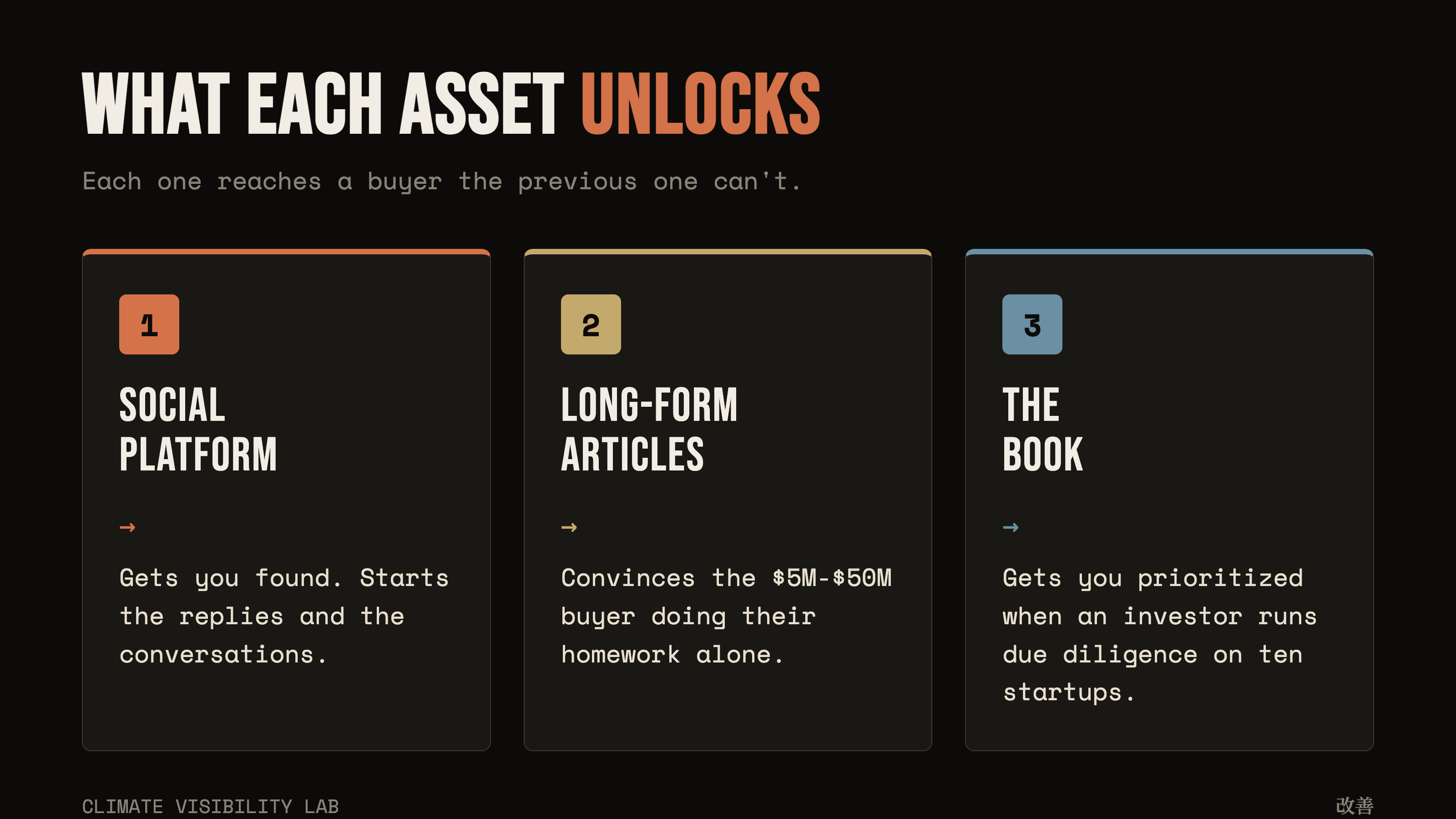
Short-form gets you found, but long-form is where you add more depth.
The non-negotiables when you expand to long-form: your company website’s blog, republished to at least one social platform. That could mean LinkedIn articles, a Substack publication, or Twitter long-form.
Optionally: you can add Medium for maximum distribution (although research shows it helps SEO, and hurts AEO, so pick it based on your goals), Reddit if your audience genuinely hangs out there, and maybe one or two more social platforms.
Why bother, when a post takes 20 minutes and an article takes half a day?
Because depth builds a kind of trust a post can’t.
An article is where you expand on your own ideas: more research, more playbooks, more worked examples. A short-form post simply doesn’t have space for it and its longevity is much lower.
It’s also how you reach a more sophisticated type of buyer.
Short-form content is great, but to someone writing $5M-$50M cheques, it’s noise pollution. That person does their homework the way my high school teachers would salivate over: Gartner’s buyer research puts it at roughly 80% of the buying journey completed before they ever contact you, and 33% of buyers would prefer a completely sales-free purchase. That homework happens on long-form content. Yours, or somebody else’s.
Long-form is also your perfect middle-of-the-funnel content, the bridge between your distribution and your offers. Translation: use it to guide your readers further down the buyer journey, using this as an opportunity to get them into your email list, demo calls, or free trials.
And it’s the format AI search actively cites right now.
When a buyer asks ChatGPT or Perplexity who’s solving your exact problem, the answer gets pulled from somewhere. Semrush studied 89,000 LinkedIn URLs cited by AI tools in March 2026 and found articles make up 50–66% of cited LinkedIn content, while Otterly’s June 2026 tracking puts articles at 63% of cited URLs, at 8.5 citations each versus 5.9 for an ordinary post. Structure the article properly, with named sources and specific numbers, and a 2026 study across six generative engines found that alone lifts citation rates by 17.3%.
(This whole article is a prime example of it)
Does writing a book actually make a founder more credible?
There’s something strange about people being book authors. And about people wanting to be book authors, too.
It’s almost tapping into a societal expectation, maybe a bit of a class perception. Because technically everyone can write a book nowadays, but not everyone can write a book, if you know what I mean.
More precisely, writing a book has always been seen as a large task that only truly committed people can do.
I mean, yeah, there are crappy books out there, but it’s a lot of effort. To write a good book is a LOT of effort.
So whenever someone says they wrote a book, at the very least, it tells you they’ve put in the work and that they’re a “serious person”.
There’s actual research on that perception, too. Psychologists call it the halo effect: one strong signal colors how someone judges everything else about you. Edward Thorndike first documented it in the 1920s while studying military performance reviews, where officers who scored high on one trait got rated high on unrelated traits too.
It’s the same bias working when “wrote a book” turns into “serious person” in a reader’s head.
Now imagine you’re an investor doing due diligence on ten different startups at the same time, and only one of them has a book author as one of the founders.
You’re gonna be curious, because that’s kind of impressive, right? And you’re gonna prioritize and put extra time into the discovery of that person.
A book is also a really cool asset that you can give away physically, in a print version, to your clients, partners, and employees. And it’s a great lead magnet if you ever want to use it as such.
It’s also much easier to write if you have the previous two assets (short-form social posts and long-form articles). When your social platform and long-form content are done right, you end up building an evergreen content library. A book is basically a collection of smaller pieces. For example, a bunch of articles curated into a book.
And I think the last, most important reason for 2026 is that nobody will ever read an AI-generated book.
AI-generated LinkedIn posts are a thing. AI-generated articles are a thing. And people have no shame in doing that.
But generating an entire book with AI is an incredibly lazy job, and people would never read it.
In fact, just the thought of someone asking me to read their AI-generated book makes me feel yucky and slimy (as I’m sure you feel the same way).
So there’s almost a quality bar, you know? You wouldn’t ever expect someone to have used AI to write a book, with slop as the result.
And so when someone hears, “Oh, you wrote a book,” they sort of expect you to have put time into it. And time can mean quality, which is something that’s easily missed when over-relying on AI.
Now, unfortunately, the climate tech category is quite scarce for examples on what each of those assets are. Most of the content that’s genuinely good comes from climate researchers and journalists, not founders.
For asset one, I always point to my client Joanne Howarth. For assets two and three, I genuinely couldn’t find any. So I’m contributing to both myself. This article is part of my effort to fill in the gap for Asset 2 and, little teaser for you, I’m finishing my first ever non-fiction book, which is in the climate tech category.
(Side note: I was talking to my book cover designer, Georgie, and we both realised that “climate tech business non-fiction” doesn’t really exist as a book category, so I might genuinely be among the first. Pretty cool, right?)
Does the order you build these content assets in matter?
Yes, and quite a bit.
Year 1 is when I’d focus on socials and articles. Year 2 is the book year.
They’re sequential for a reason. Short-form lets you test a BROAD range of topics fast. From it, you take the best performing ones and expand them into articles in Month 7. Then you do the same with articles, and in Year 2, combine them into a book. Each article essentially becomes a proven sub-chapter.
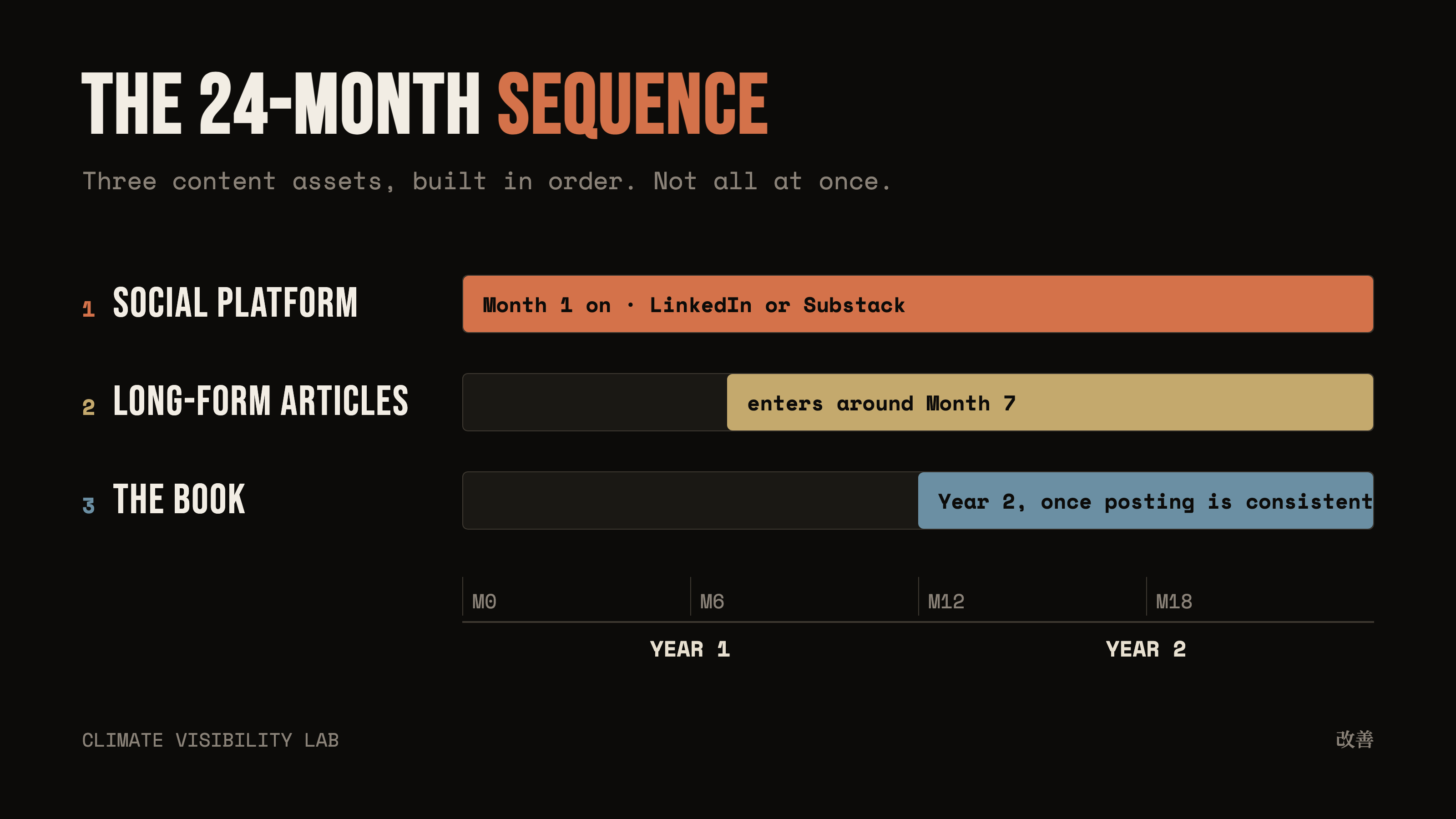
Don’t have the time for all of it? Compress it instead of skipping it. Make the book your end goal, then reverse-engineer backward from it: the minimum viable version of the platform and the articles that still gets you there.
One caveat though: this works best if you’re Series A or later, with more time and more already achieved. At pre-seed or seed, it only works if you’re a serial entrepreneur. That doesn’t mean you shouldn’t invest in socials and articles now (I’d actually VERY MUCH encourage you if you have the resources), it’s just going to take longer.
Alright, those are the 3 assets.
Would love to know if you’ve ever seen it laid out this way.
Talk soon,
Roman
This went out to Climate Visibility Lab subscribers on Thursday. One strategic essay a week on going from invisible to investable as a climate tech founder. Read it first, free.
PS. If you want to start with asset one, that’s exactly what a Visibility Audit is for. I’ll research your footprint, show you where you’re invisible, and sketch your 2-year roadmap: LinkedIn foundation first, then niche media, then long-form, then the outline of a book.