I've been ghostwriting for an ESCO founder close to 1.5 years now.
Naturally, as he's scaling his company he's very selective about the types of events he goes to. Not all of them are worth the time and effort. ESCO Symposium, however, felt different.
Perhaps it's because he was a speaker at the Istanbul event last year.
But after attending the one in Madrid, I reckon the reason is much simpler.
It's the people. Last Thursday, I got back from Madrid feeling like I've talked to someone from every corner of the ESCO world. 'International' in the event's name truly means just that.
And because I'm not an extremely versed ESCO professional (yet) and it was my first time attending there were 3 things that surprised me:
1/ How similar White Certificates are to carbon credits.
I'm gonna be biased here.
Carbon credits are, in my opinion, a scam.
Can they be used for good? Yes, the potential is there. But can they be abused? Sadly, that's how most of them are.
My biggest issue with the idea of carbon credits is that it gives the big polluters an excuse to buy them, which supports the smaller businesses, sure, while they continue to pollute.
But that's a whole 'nother wombat hole I don't want to get into here.
So what got me so riled up?
Well, White Certificates have quite a bit of overlap with carbon credits:
- Each certificate stands for a verified quantity, counted against a baseline: measure before the work, install, measure again.
- A certificate is issued only after the savings are verified. Poland estimates the savings up front and confirms them afterwards.
- Independent verifiers make the first check. Spain is reforming how those verifiers are themselves checked.
- A registry or platform records who owns each certificate and transfers it, in Italy from the ESCO to the supplier that has to buy it. Spain is building an electronic platform for this.
- Supply and demand set the price. Poland trades them on its power exchange, and Spain is moving to auctions.
- The Spanish policymaker on the panel called the certificate a financial asset, twice.
- Selling the certificates is extra income that shortens the time a project takes to pay for itself.
- The project’s developer, usually an ESCO acting as a consultant, prepares the project and files it.
- Private money pays, not the public budget. Only the administration is public.
- Fraud is a risk in both. Italy saw shell companies file false projects worth hundreds of millions of euros a year, and France had the same problem.
- Both need someone to set the rules, run the system and check that the savings are real.
There’s less room for abuse, sure, but the overall concept is worryingly similar.
2/ No Finnish ESCO representation at the event.
In fact, I was the only guy from Finland, and I don’t even run an ESCO.
There are, of course, ESCOs in Finland, so it's more of an absence from the event, rather than the market. But it got me wondering why, even upon a simple search, I could hardly find anything.
And a bigger question of why hasn’t Finland developed a larger, more visible ESCO market?
1. Customers often implement the easiest projects themselves.
Finland's energy audits and efficiency agreements already show customers the attractive upgrades, and they fund those themselves. ESCOs get what's left: the complicated, less profitable projects.
2. Contract costs can outweigh the potential savings.
An ESCO project needs a savings baseline, a guarantee, a risk split and someone to verify the result. When the savings are modest, the paperwork costs more than it's worth.
3. Procurement processes don’t fit the model well.
Public-sector buying rules weren't built for long, performance-based contracts. Buying an upgrade is familiar. Buying guaranteed savings isn't.
4. Buyers don’t always understand the idea.
Finnish research found customers don't really understand the ESCO model. So the ESCO has to sell the upgrade AND explain why its model beats doing the work in-house or hiring a normal contractor.
5. Finland has used a narrower definition of “ESCO.”
Historically, Finland’s definition focused on energy-efficiency improvements, while some countries included broader building-renovation services. That makes Finland’s ESCO sector look smaller in international comparisons that count different activities.
All are valid reasons, of course.
And all, in my honest opinion, can be made easier through more market education.
3/ How much jargon there is.
I’ve talked to financiers, brokers, ESCOs, and representatives from the UN.
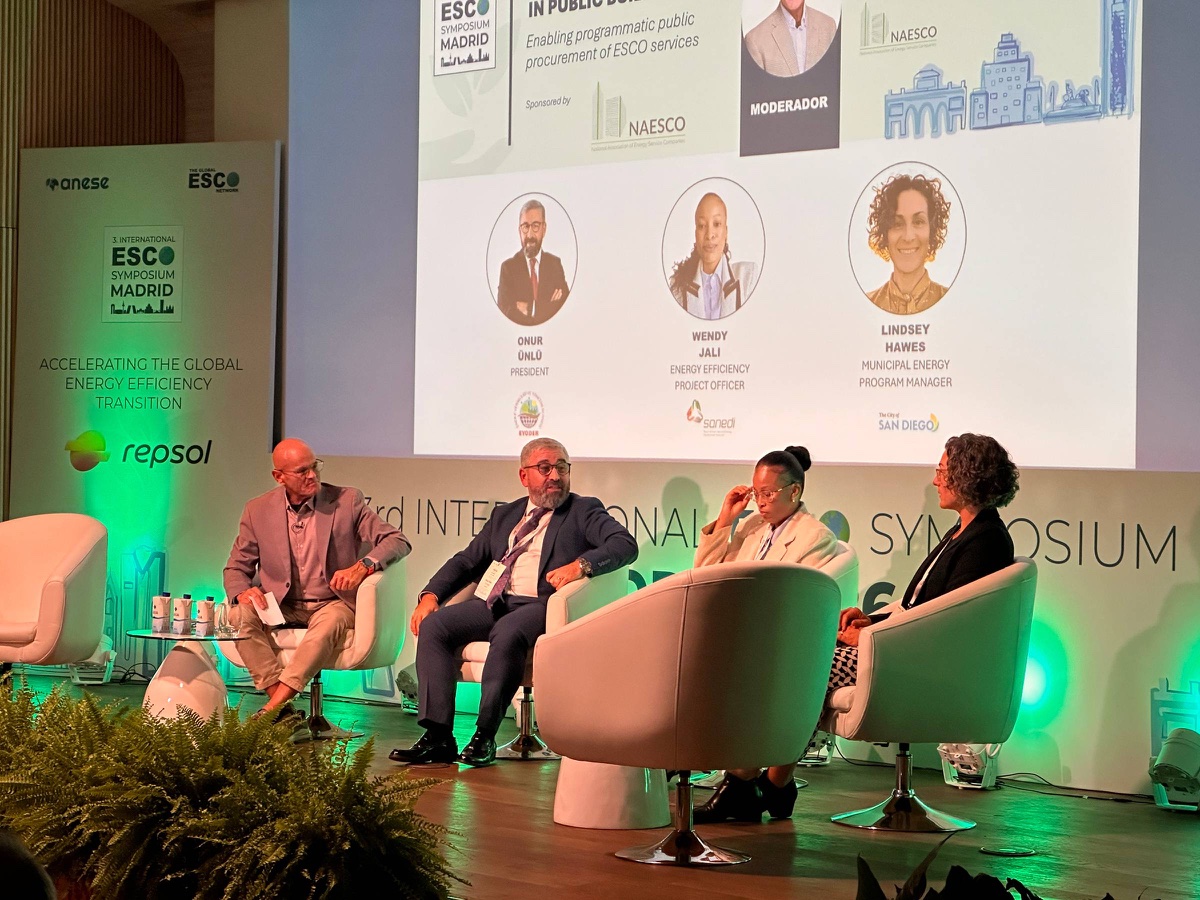
Pretty much everyone agreed that the language used is MAYBE fine for these kinds of events since you're talking to peers, but when talking to target buyers it’s a huge issue.
Some examples from the event I noted down:
- Example #1: “not have any impact on the client financing capacity because it’s non-recourse.”
- In plain English: if the project fails, the lender can’t go after the client’s other assets, so the client can still borrow for other things.
- Example #2: “It starts with program design. It starts with aggregation. It starts with delivery mechanisms. It starts with capital mobilization, and finally, finally, then with independent verification of M&V.”
- In plain English: plan the programme, bundle the buildings together, decide who does the work, find the money, and have someone outside check the savings.
- Example #3: “12.3 million euros of partial credit guarantee fund with IDC, which is an industrial development corporation, which then secures a portion of the loan to the escos.”
- In plain English: a state-backed fund covers part of the bank’s loss if an ESCO can’t repay, so banks agree to lend to ESCOs.
The problem with this kind of language is it's unclear to your ICP.
When you're writing a LinkedIn post, a speech, or a video script, your audience is almost never your fellow ESCO expert.
It's the end customer. People who move into the retrofitted houses. Who only care if their home is warm or cold. Or if their electricity bill is fair.
And, to no surprise, many people working on the other end of ESCO deals, i.e. in public sector, are no different.
Also, apparently standing and eating finger food is a typical Spanish lunch.
Had no idea THAT was tapas.
Overall, I definitely learned a lot.
And I walked away feeling quite hopeful. Mostly because I was the only comms/marketing person there which means there's a massive potential for improvement in marketing and messaging across the board.
But also because of the speech at the end by Søren Lütken, co-chair of the Global ESCO Network and a senior economist at the UNEP Copenhagen Climate Centre.
He emphasised that this industry has been talking about the same topics and solutions for 20+ years every single year. Very little has changed. Yet the global warming is only worse and 1.5C threshold has been breached twice.
This space needs a new way of doing things.
And perhaps fresh outside perspective.
Talk soon,
Roman
Whenever you’re ready, there are 3 ways I can help:
1/ Get a copy of my book → It’s called From Invisible to Investable: The 7 Stories Every Climate Tech Founder Should Tell Online to Get Backed, Booked, and Believed In. Perfect if you’ve never shared stories online before.
2/ Use my Climate Tech Post Vault → my 55 most reused LinkedIn post templates. The posts behind them pulled 13,321 reactions, 2,187 comments and 999,365 impressions.
3/ Buy your In-House Ghostwriting OS → An all-in-one system for solo marketers and small marketing teams in climate tech companies to create, launch, and grow a system for building their CEO’s personal brand on LinkedIn.