New Year is coming and with it changes in how everyone's doing their content.
Some people go all in on AI (a very common shiny object right now). Some go back to basics (my approach). And some take a blended approach.
But arguably the best way to make the most of your existing articles, with or without AI, is to maximise their distribution.
In plain English: how can you share it in as many places as possible as fast as possible?
Now, the most obvious and common options are:
- Turning it into short-form social content
- Sharing it as an email newsletter
- Publishing it as a website blog
This is the bare minimum that every business should have.
And there are 100s of blogs and pieces of content about this online so I won't be covering them (unless you really really want me to, then pls let me know).
Today, I wanted to focus on more creative options that are equally if not more powerful than the obvious ones.
Shall we?
1. A social media article.
Now, every platform has been evolving A LOT in the past 12 months.
The primary reason for it is intense competition. Social platforms are engineered to keep you glued to them 24/7 and they do everything in their power (like the dumb puzzle games on LinkedIn) to never let you go.
But it also resulted in some pretty significant differentiation and content formats that are uniquely doing well on each platform.
Option #1: LinkedIn Newsletters
When I first heard of this, I immediately asked why would anyone do this to themselves?
LinkedIn Newsletters have one GAPING disadvantage: they offer no email capture at all. So I ignored it for years thinking it was a waste of my time.
But in 2026, they've had a resurgence for two specific reasons:
- With the rise of AEO (or Answer Engine Optimisation; or AI citations in short), LinkedIn is now one of the three most-cited domains in AI answers, and the only professional one. Semrush found it in 14% of ChatGPT Search answers, behind only Reddit. That means every time you ask ChatGPT or the LLM of your choice a question, there's a decent chance it references LinkedIn as a source. And of all the LinkedIn pages AI answers cite, about 60% are articles and a third are feed posts. A newsletter edition is an article.
- Top LinkedIn thought leaders use it to boost their engagement. There's something about the format that simply makes it outperform individual LinkedIn articles. Perhaps it's the fact that your entire network gets notified every time there's a new article out.
If your goal is to get cited and simply have your content present on as many surfaces as possible, this is a great format to use.
I discontinued weekly LinkedIn newsletters in October 2026 because I decided to double down on my email list growth and republishing each email as a LinkedIn newsletter simply gave no incentive for my network to sign up to the email version.
Important note as well:
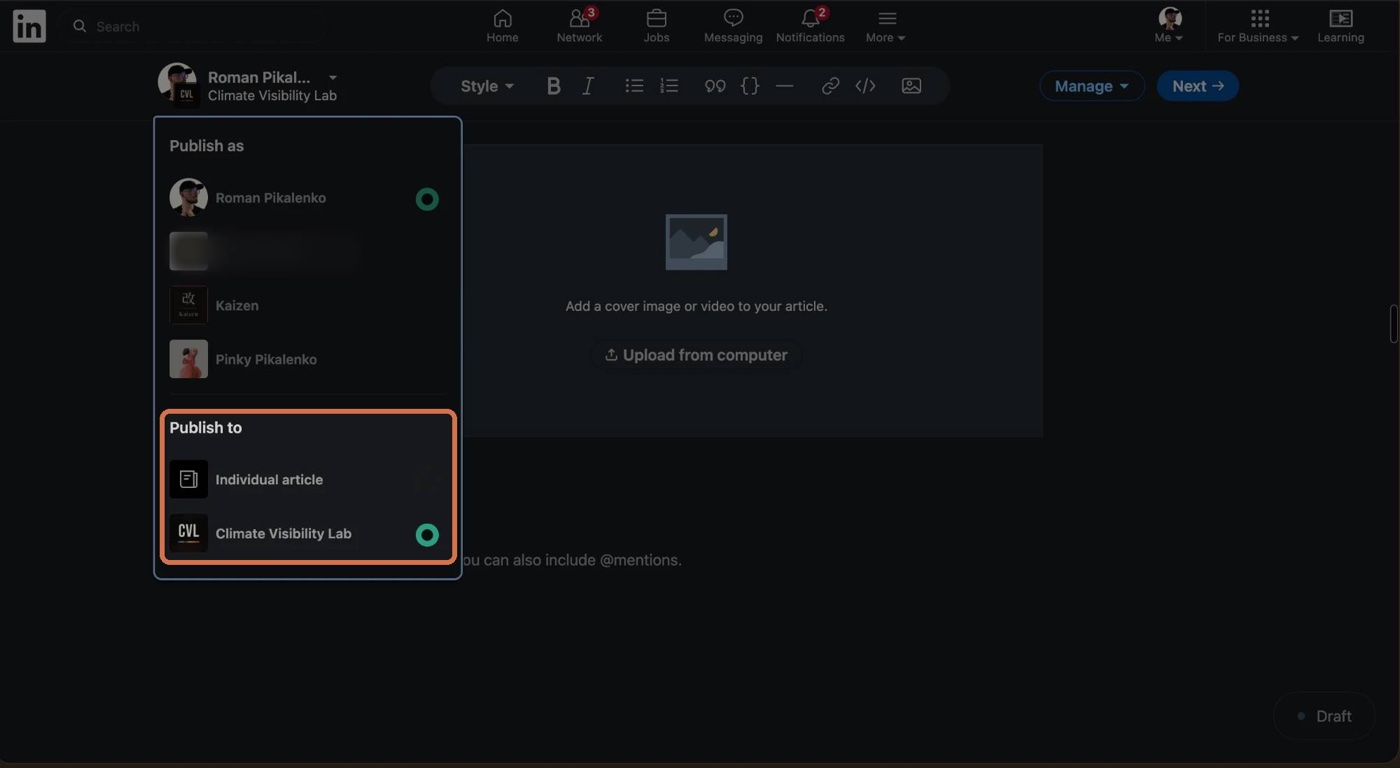
LinkedIn Newsletter ≠ LinkedIn Articles.
Articles are individual content pieces that are not part of a publication on your LinkedIn profile. A LinkedIn Newsletter is part of an existing series.
You can easily tell which one is which if you see something like this:
Option #2: Twitter/X Articles
If you think Elon Musk is some kind of genius messiah, you need a doctor.
Preferably a lobotomy.
Man went and bought an entire social platform turning it into a clusterf*ck I don't even want to get into.
That, among many other reasons, is why I would strongly discourage people from ever using Twitter* for their marketing.
However, if you're curious, don't care, or believe using a text-first platform with half a billion users simply has more pros than cons, then you should know about Twitter/X Articles.
Right now it's one of the easiest formats that goes viral on the platform. Threads are pretty much dead. And single Tweets work, but don't compare to articles.
All of it is thanks to recent algorithm changes which shouldn't be surprising if you know anything about the lifecycle of social platforms.
When platforms struggle, they find creative ways to survive. For Twitter, there are 4 core reasons behind it:
- Retention: Twitter/X wants people reading full articles on-platform instead of clicking away to blogs or Substack.
- Premium subscriptions: Making Articles available to Premium users gives writers another reason to pay.
- Attracting writers: Bigger creator payouts and a $1 million Article prize encourage original, substantial content.
- Keeping engagement in-house: Twitter/X link clicks fell 28% in Metricool’s study, even as replies and reposts improved. Conversation isn’t necessarily translating into website traffic.
In short: Twitter/X is great if you want to maximise number of platforms you're on and potentially capitalise on the engagement boost.
But if you care about ethics, there's a much better platform for it.
*Yes, I refuse to call it X.
Option #3: Substack Publication
This is the most beginner-friendly platform for both short-form and long-form in 2026.
I've been on the platform for about half a year now and I enjoy it a lot. Conversations are more grounded without any Twitter trolls. It's easy to find your way around. And some of the best investigative journalism is published on Substack.
If I didn't have LinkedIn, I'd go all in on Substack.
So why should you consider republishing your article as a Substack publication?
- Substack raised $100 million in July 2025 to invest in better tools, broader reach, and creator support. It’s actively building out the infrastructure, not just letting you send newsletters like it used to.
- Substack already has more than 5 million paid subscriptions, up from 2 million in 2023. It's the Golden Age right now.
- One article can become the starting point for a much bigger publication: Notes for discovery, podcasts and video for repurposing, and paid subscriptions for monetisation. Substack is also rolling out podcast sponsorship tools, opening another potential revenue stream.
Do you have to use all the extra features?
Not if you're tight on time and resources. But do use the free publication itself and chop it down into Substack Notes to drive some extra traffic.
2. LinkedIn & IG Carousels.
Everything is a list.
And your article should simply be an expanded version of that list. Just look at this article here. I'm literally listing different ways of reusing the same content, right?
And carousels are a perfect format to reuse your existing articles.
Because if everything is a list, then:
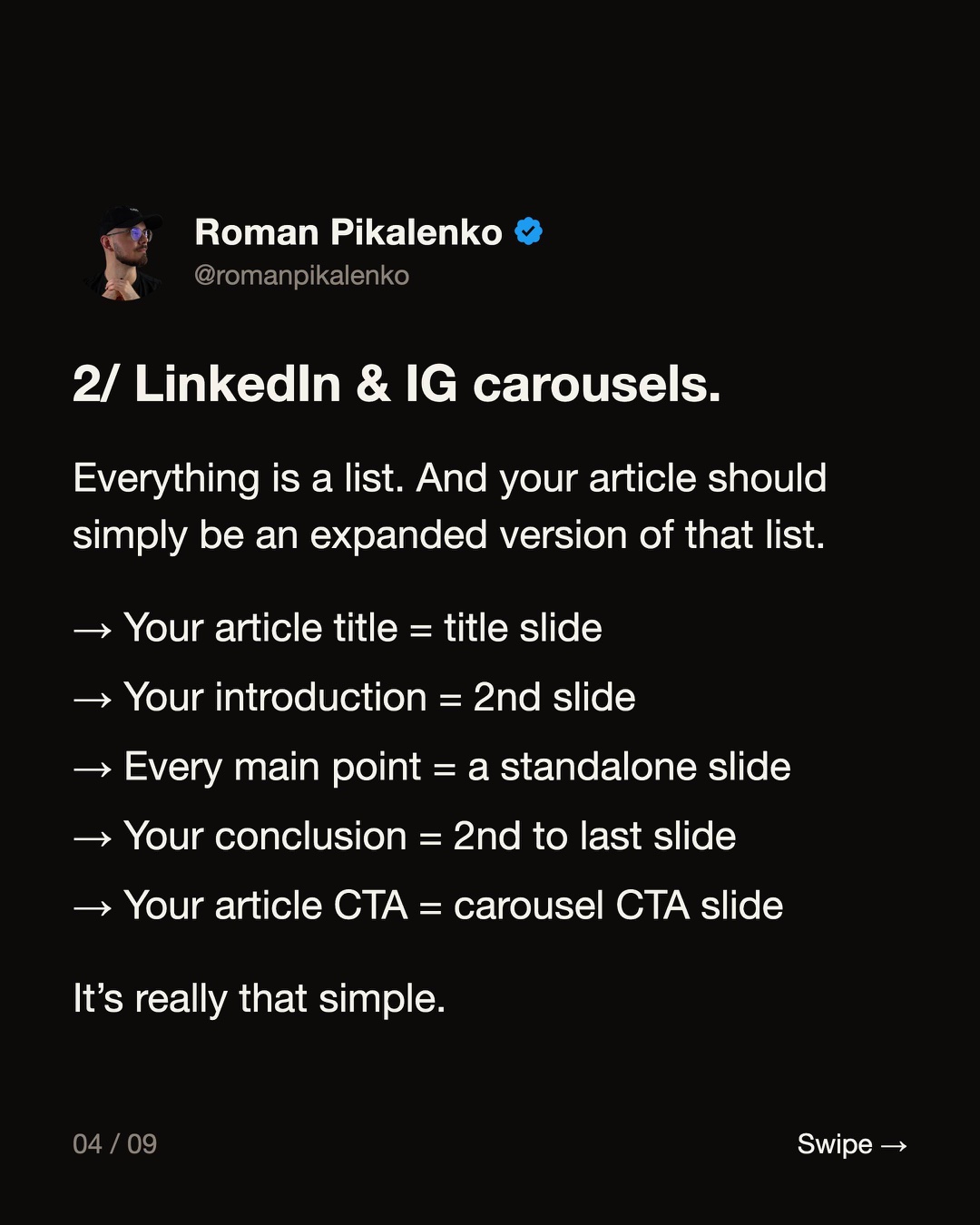
- Your article title = title slide
- Your introduction = 2nd slide
- Every main point = a standalone slide
- Your conclusion = 2nd to last slide
- Your article CTA = carousel CTA slide
It's really that simple.
And right now, there are two platforms that are great for carousels: LinkedIn and Instagram. The only caveat is that you want to have a bit of a teaser copy in each carousel post's caption.
But make sure to leave most of the content to the carousel so the reader spends most time scrolling.
3. Reddit
This is the most underrated channel.
But it's also very 'niche' so I would only use it for one specific reason: you want to double down on AEO. Reddit, believe it or not, is THE most cited social platform, even more than LinkedIn. In Peec's March 2026 analysis of 30 million AI citations, Reddit came first, YouTube second, LinkedIn third.
But you don't want to be copy-pasting your entire article to Reddit for this.
The way I'd do it is slightly different:
- Find Reddit threads that ask topic-relevant questions
- Take a section of your article that answers it
- Paste as an answer
- Make slight edits
- Publish
A past client of mine that's growing an AWG company is very bullish on this approach because there are many Reddit threads talking about myths and scams around AWG.
His space struggles with trust building.
So what's a better place than where people are the angriest to address those issues?
4. Your next webinar event
I don't even know how much I need to explain this one.
If your article answers a burning question your ICP has and/or it gets good engagement or traffic, turn it into a webinar.
It's really that simple.
(I say that a lot, don't I?)
A few tips to make the most out of your webinars (from beginner to advanced):
- Beginner: make sure to collect people's emails. You can have a simple Kit or HubSpot form that redirects them to a thank-you page.
- Intermediate: with the guests' permission, chop up the video into short-form video clips. Riverside is great for it (and for hosting the webinars). Or paste it into Claude Code and ask it how you could make it happen. I have a set of tools I use via Claude Code for my short form videos (let me know if you want a guide).
- Advanced: have an educational email sequence before and after the event. Webinars on avg. have ≈50% attendance rate so pre-event sequence helps bump that number up. And post-event sequence is great for converting them to whatever the next step is, i.e. booking a call with you.
And if you're a bit of a maniac, turn it all into a podcast.
10x harder, 100x the return.
5. Sub-chapter of a nonfiction book
This is my favourite type of content at the moment.
Partly because I recently published my own nonfiction book. But also because in the process of writing it, I realised how much more accessible it is to become a book author nowadays and the benefits of doing so. And climate tech is severely lacking great books on the shelves.
Now, a book is a huge project no matter how you approach it.
Or is it?
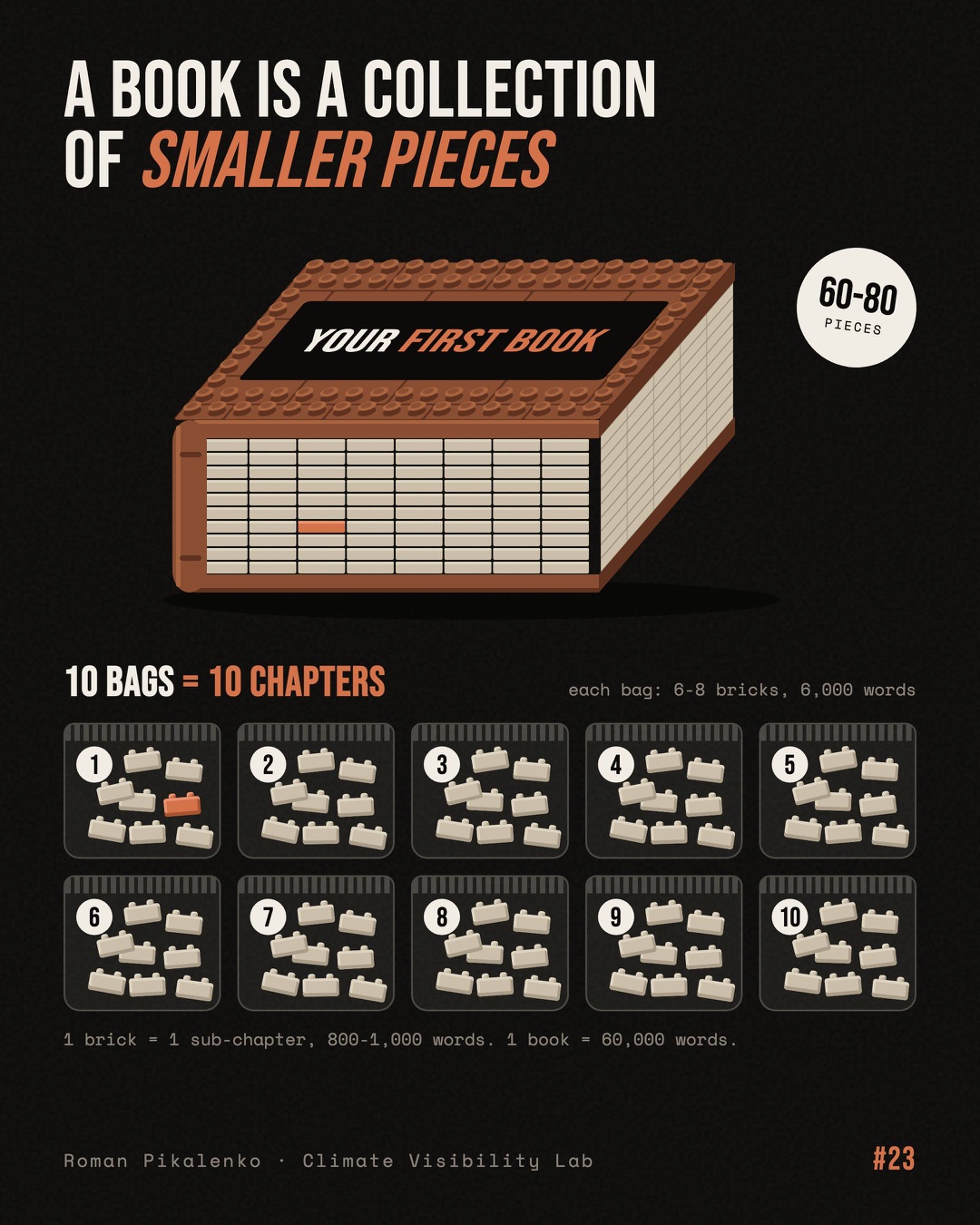
Let's say a book is 60,000 words. You could look at it as 10 Chapters that are 6,000 words each. Each chapter containing 6-8 subchapters 800-1,000 words each.
And each subchapter is essentially your thought leadership article.
How I'd plan the entire nonfiction book from scratch in 4 steps
When you break it all down that much, it's easy to see that a book is really just a collection of smaller pieces of writing.
So here's a quick crash-course on how I'd go about writing my next one (or ghostwriting one for a client):
- Step 1: Your short-form social content. Think posts on LinkedIn or Substack. These act as your rapid ideation engine. I recommend you do this for at least 6-12 months before you expand into any new format.
- Step 2: Look at what works. Expand them into 800-word thought leadership articles. This is where you are now whether you started with short-form or not. And this is where you want to spend another 6-12 months iterating each idea further.
- Step 3: Pick the most popular, well-received topic. Perhaps you've written on how to make ESCOs profitable and gotten great engagement. Or every time you share a lesson from growing your business, you go semi-viral. Those are signals and data worth paying attention to.
- Step 4: Collect everything. Your library of content that can become part of your book. Honestly, at this point you might have 75% of the book already written. The last 25% is new details and stitching it all into one compelling narrative.
Think of your book as LEGO Hogwarts Castle. You got sections of it. And you build each brick by brick.
But what if you want to go straight into writing the book and skip socials?
3 Extremely important reasons not to start with the book before short-form posts and long-form articles.
I used to work with a top circular economist out of Amsterdam who was in the middle of writing his book.
Great guy. Yet he was tormented by the pressure of producing something perfect. His editors were on him all the time, he had increasingly frustrating deadlines.
Suffice to say, I didn't feel jealous of his position.
The book was his baby.
And, whether you like it or not, you will get emotionally attached to it because of how much publishing one demands. And all of that stress piles up the moment you decide to skip the necessary steps before you write it:
- You obsess over a topic that's unproven. Will the readers like it? Well, you don't know, but it HAS to be perfect!
- You might produce something that nobody buys or reads. If you're self-published, you hear crickets. If you're traditionally published, you'll have wasted months (or years) and thousands of euros on the project only for it to never reach the book shelves.
- You have no platform of your own to promote it after it's published. That's the true beauty of writing short-form first, articles second, and only then the book. Once it's released, you own the whole supply chain of marketing.
Now, can you succeed and become a bestselling author with just going with the book?
Sure. But it'll be 100x harder is all I'm saying.
And there you have it.
5 extremely specific, I like to think creative, ways of how to turn a single thought leadership article into at least 5 (or more) assets that keep on giving months and years later.
Sounds overwhelming?
I feel the same most of the time.
But the difference between you and me is that you're running an amazing climate tech company solving some of the world's most pressing issues and I quite literally made everything I talked about above my career. And I love it. I'm also good at it.
So, if you have a library of long-form articles you know are collecting dust but deserve 10x more exposure, let me help.
Talk soon,
Roman
Whenever you’re ready, there are 3 ways I can help:
1/ Get a copy of my book → It's called From Invisible to Investable: The 7 Stories Every Climate Tech Founder Should Tell Online to Get Backed, Booked, and Believed In. Perfect if you've never shared stories online before.
2/ Use my Climate Tech Post Vault → my 55 most reused LinkedIn post templates. The posts behind them pulled 13,321 reactions, 2,187 comments and 999,365 impressions.
3/ Buy your In-House Ghostwriting OS → An all-in-one system for solo marketers and small marketing teams in climate tech companies to create, launch, and grow a system for building their CEO’s personal brand on LinkedIn.