I've been writing for an ESCO founder for over a year now.
Not too long ago, I got curious about the state of their overall content (I was only doing the founder's LinkedIn). Specifically, other socials, their blog, web copy, email marketing, and LinkedIn company page. I was at a stage when my offer was evolving beyond LinkedIn-only and this was part of my market research.
But I didn't expect what I saw...
...AI freakin slop.
I mean I talk about it all the time but I didn't think it'd make its way into climate tech business that was quite profitable.
So naturally I asked my client who was in charge of it.
They hired a generalist marketing agency to do their website blog and LinkedIn company page posts.
Suuuuuper common in B2B marketing.
Even before AI, marketing agencies that offered 10 different services to anyone with cash, were popping up left and right.
That alone should be a red flag if you're a climate company looking to hire marketing help that is both good at marketing and knows your space.
This agency was primarily focused on two things:
- Producing 1x blog article per month
- Writing 3 LinkedIn company page posts per week
A bit of a strange mix if you ask me, but that don't matter as much.
Let's go over a few issues I spotted though.
First, I noticed 3 big problems with the blog articles.
I've been writing long-form in different formats for 5+ years so these stood out like a sore thumb to me:
1/ Frequency.
Once per month is the absolute bare minimum. I knew my client wanted a healthier MOF and their work is extremely technical (LED upgrades). That means if you wanted to address every buyer problem and objection, it'd take them years to do so.
2/ Length.
Each article was 300-500 words long. That's a LinkedIn post, if you ask me. Too thin to share something valuable. I always recommend a 800-1,500-word range to be able to add depth to each piece. So my client was basically paying for 1/2 an article every month.
3/ AI tells.
I have nothing against em dashes, but they were overused here. Also, the blatant use of 'not X, but Y' structures, logic that lost me halfway through the drafts, and clever aphorisms that didn't actually mean anything. I spent 6 months at some point trying to outsource my writing to AI (unsuccessfully) so I was very familiar with what AI produces in text.
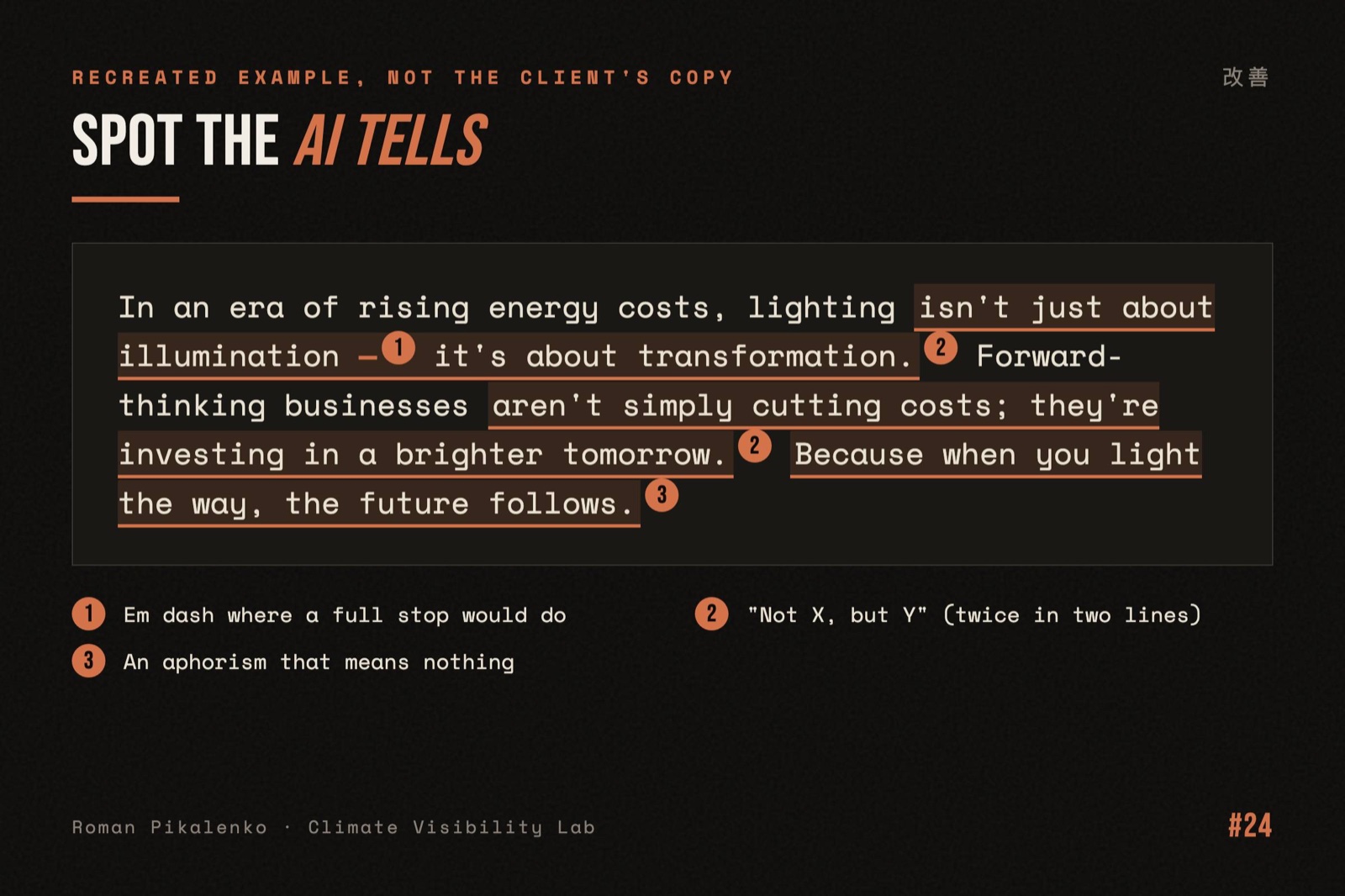
Is your blog like that?
If it has at least one of those three issues, I encourage you to either pause and clean up or double down on the right way. More on that below.
Second, I flagged the LinkedIn company page posts.
I'm generally allergic to LinkedIn Company Pages.
If you're pre-seed, its goal is to be optimised and show you're real.
If you're Seed+, it has only two jobs:
- PR: Any time there's a piece of news about your company.
- HR: every time you're hiring.
You literally don't need it for anything else.
This agency, however, seemed to put most of its output into the very channel I recommend against.
It wasn't working for 3 specific reasons:
- The content was too corporate.
- When they had a chance to share part of the company's journey, they led with 'progress without compromise' as a slogan. I'm not even scared of sharing this because it's so generic and confusing that you'll never pinpoint which company it belongs to.
- Every post was a self-promotion.
- Literally 2-3 lines in and you see a pitch of their service explaining how great it was, what made it different, and why you should buy it. While it has its place, it needs to be earned through customer education like, I don't know, talk about their problems and desired outcomes.
- Not worth their time.
- Personal profiles get a 63% higher engagement rate than company pages, according to Metricool's 2026 study of 63,000+ LinkedIn accounts. Even if you were to invest in it, it'd be an uphill battle and your resources right now are simply better spent elsewhere.
What happened next was pure luck on my part.
I caught my client going through a bit of a marketing transition.
They felt their current approach wasn't working.
Their marketing manager literally said the content felt 'bland'.
light bulb moment for me
Call it luck or business savviness, but I saw a gap and proposed an alternative.
Article Engine: A 3-Step Strategy To Get In Front Of The Right Buyers, Educate The Market, And Get Cited By AI.
It was clear that the client wasn't happy and the agency's approach wasn't working.
My plan consisted of 3 parts:
Part 1: Long-form thought leadership articles.
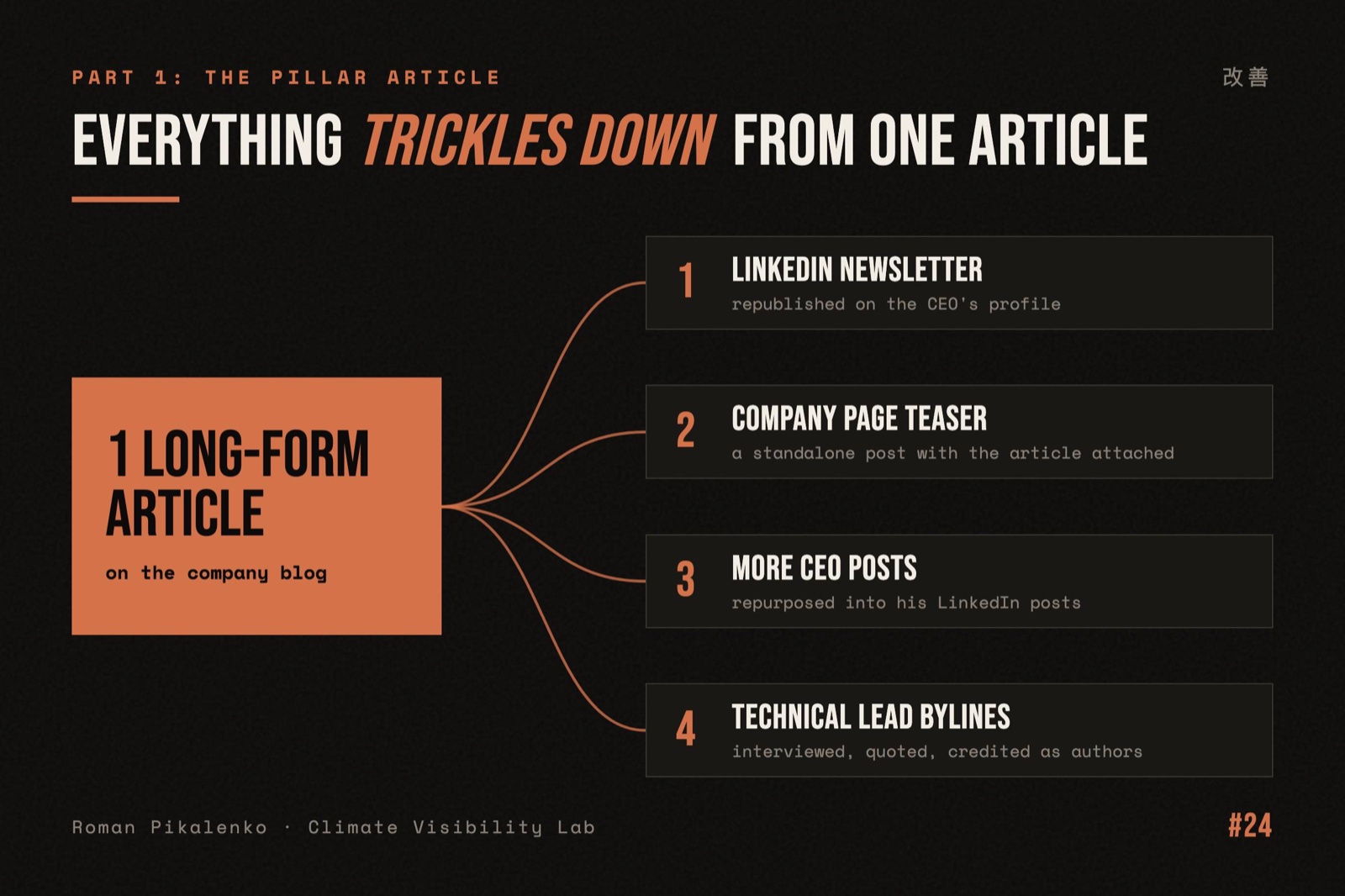
We'd treat the blog articles as the 'pillar' piece of content meaning everything would trickle down from there:
- It would be republished on the CEO's personal LinkedIn as a LinkedIn Newsletter. Great for extra distribution where the CEO is already active. Plus, LinkedIn Newsletters have better engagement than standalone articles.
- We'd promote it on the LinkedIn company page via a detailed teaser post. Each teaser is written as a standalone post with the expanded article attached to it. That way, the reader gets value whether they click or don't click on the blog link.
- We'd repurpose it into more of the CEO's LinkedIn posts. It'd be silly not to.
- And we'd even co-produce it with other executives in-house to promote their expertise. There were lots of problems their buyers dealt with that some of the Technical Leads were more equipped to solve than the CEO. So I interviewed them, used their contribution in the article, and wrote them as authors in the byline.
The goal was to start with 2x articles per month.
Part 2: AEO/GEO optimisation.
At the same time, my client was testing the new AEO features in Hubspot.
A bit of a woo woo side of me sparks up whenever I share this story because literally 2 months prior I started testing my own AEO strategy as well. So naturally, I offered what I learned as part of the deal.
What it looked like was simple:
- Every blog article was to be AEO-optimised: H2s as questions, byline, question-answer style writing, citable tables, sources, etc.
- Every month I'd report on number of citations through Perplexity. I have a 30-prompt pack that I run automatically to get surface level view of their citations.
- Every 6 months I'd run a more in-depth AI Visibility test doing the monthly check on Claude, ChatGPT, Gemini, and Perplexity. I'd also suggest 3rd party citations we should go after.
And as I'm developing my own AEO tactics, I introduce it slowly to my client as part of the ongoing upgrades at no cost.
Part 3: LinkedIn company page.
Despite me explaining what I had to you, my client insisted on a consistent flow of content here.
So we settled on a bare minimum that would also feed into the existing content loop:
- We'd only publish 1x per week so my client didn't have to do extra reviews.
- Every other week it'd be a teaser post for the new article.
- Every other week we'd either repost the CEO's top LinkedIn post from the previous week OR write a dedicated HR/PR post, i.e. they had a new case study they wanted to highlight.
That way the client was happy and LinkedIn company page wasn't used in isolation.
| The agency | The article engine | |
|---|---|---|
| Blog articles | 1 per month | 2 per month |
| Words per article | 300-500 words | 800-1,500 words |
| Company page posts | 3 per week | 1 per week |
Frequently asked questions
Chances are, after reading all this you still have a ton of follow-up questions, so I’m just going to go ahead and rapid fire them for you.
Q1: Is AI generated content really that bad?
If it’s pure 100% AI-generated writing that’s not been edited by any human, then yes.
I wish I had a different answer for you, but I don’t. I simply have not seen a company run ‘autonomous’ content systems for those systems to produce anything worth their buyers’ attention.
AI-generated is often now associated with you not putting any effort into your writing.
And if you didn’t care enough to write anything would your buyer care to read it?
Q2: Aren’t specialist agencies even more expensive?
It honestly depends.
For example, in my client’s case, they actually are saving £300/mo by having switched to me because that other agency was overcharging them. But that’s not always the case.
Q3: Our investors made a comment about our LinkedIn company page looking dead. Should I still ignore it?
It’s very unlikely they meant “we want you to post 3x per week on your page or else”.
What they probably meant by it is:
- There’s been ZERO activity in the last couple of months
- The page is incomplete, i.e. team not linked, website is not listed, about section is barebones
All of it can be solved through the system I covered above.
Now why am I telling you this story?
First of all, I genuinely wish more marketing teams in climate would avoid generic agencies. It wastes a ton of time and money, makes it harder to justify the next marketing investment to your leadership, and hurts your (and company's) reputation.
Second, and I hope this was a helpful article so far, if you're dealing with the same problem, just know that I offer free Visibility Audits part of which is me going through your content the same way I did for my client.
I know I know, how dare I pitch you, right? Well, I hear you. But I tried to hold off till the very last point. You genuinely don't have to.
Take everything I said, turn it into a checklist, and audit it yourself. You'll already have a bigger win than doing nothing.
If you do need help, find the time that suits you here or reach out to me directly.
Wishing you a slop-less Thursday,
— Roman
Whenever you’re ready, there are 3 ways I can help:
1/ Get a copy of my book → It's called From Invisible to Investable: The 7 Stories Every Climate Tech Founder Should Tell Online to Get Backed, Booked, and Believed In. Perfect if you've never shared stories online before.
2/ Use my Climate Tech Post Vault → my 55 most reused LinkedIn post templates. The posts behind them pulled 13,321 reactions, 2,187 comments and 999,365 impressions.
3/ Buy your In-House Ghostwriting OS → An all-in-one system for solo marketers and small marketing teams in climate tech companies to create, launch, and grow a system for building their CEO’s personal brand on LinkedIn.