Laurence Kemball-Cook is the founder and CEO of Pavegen, a British company whose triangular floor tiles turn footsteps into off-grid electricity and data. One adult step sinks a tile 5-10 millimetres and returns 3 to 5 joules of electricity; the tiles are now in 37 countries across 250+ installations, with over a billion steps logged. He built the first prototype in 13 hours after being fired from his placement year, was told by every London VC and a UK government tech body that it would never work, and once installed a tile outside the London Eye with no permission to force the point. Here is how the tile works, where it runs, and where Pavegen stands 16 years in.
Welcome to the 2nd official edition of Climate Founder Letters, a newsletter version of what many of you might know as Climate Founder Mondays on my LinkedIn and a new sub-series under Climate Visibility Lab. If you’re not, CFMs have always had one purpose: highlight most influential yet underfeatured climate tech founders out there, specifically focusing on their stories over their tech. Everyone covers tech.
But I realized that tech is essential to everything these awesome founders do. So, to fit in both elements I’m expanding the format to long-form. Enjoy and let me know your thoughts.
When Pavegen’s founder says “you can’t be cool forever,” you assume he means the company
Well, not really. When I interviewed Laurence Kemball-Cook, CEO at Pavegen, he meant the headlines. Sixteen years in, he thinks the company is more interesting than ever.
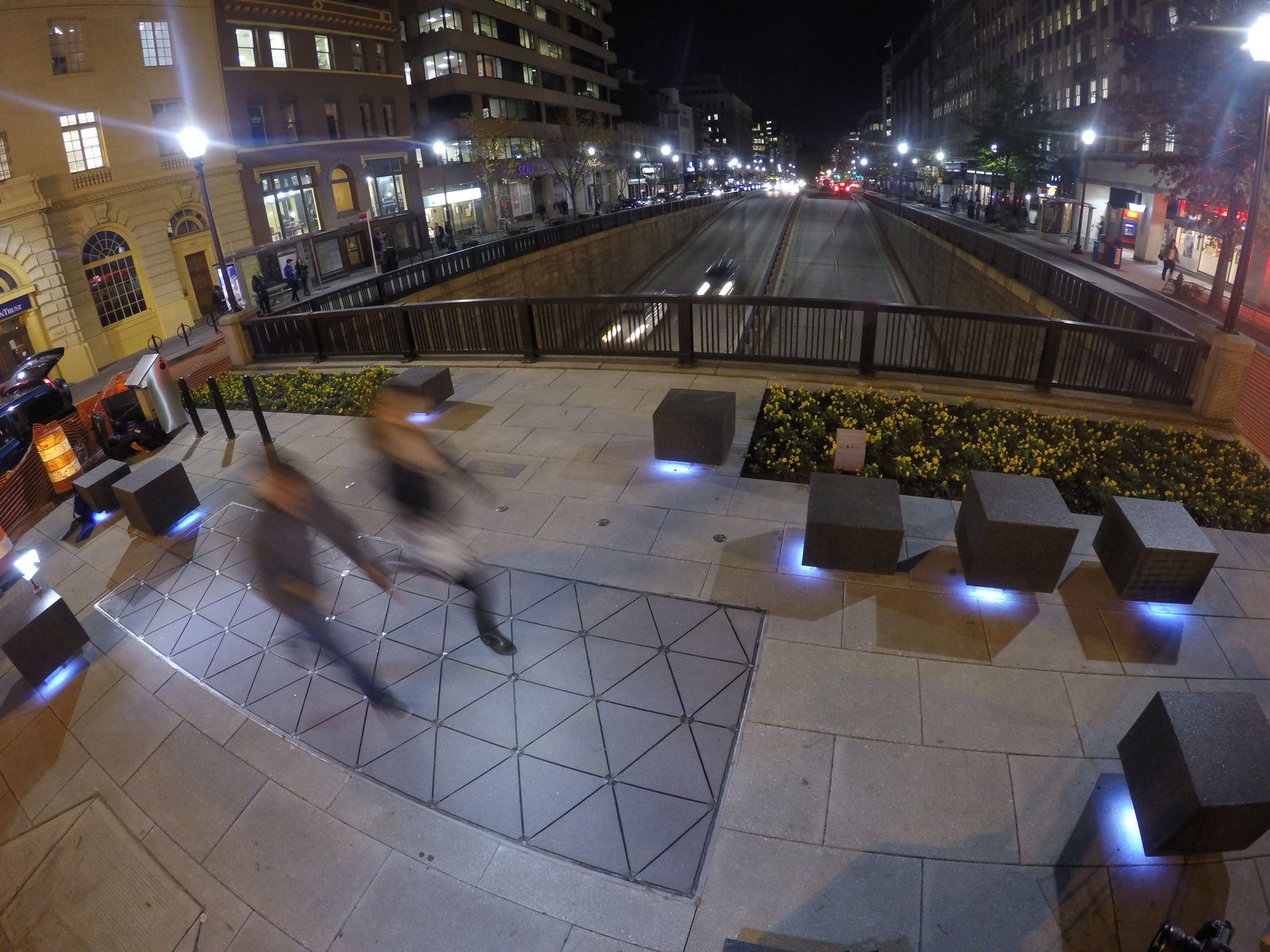
Five years ago you couldn’t miss Pavegen. Tiles at Heathrow. A pocket park near the White House lit by the people walking through it. A football pitch in a Rio favela, opened with Pelé in tears.
Then the market turned, and AI took the headlines.
Today: about 25 people, tiles in 37 countries, and million-dollar deals in Saudi Arabia.
His name is Laurence Kemball-Cook, founder and CEO of Pavegen. Their floor tiles turn footsteps into electricity and data.
So, in this issue, we’ll cover:
→ Who Laurence is, and how a fired intern got here
→ How the tile works, and where it’s installed
→ Where Pavegen stands now, in his own answers
→ What all of that looks like from his LinkedIn
Let’s get into it.
Who is Laurence Kemball-Cook, and how did Pavegen start?
Before the tile, Laurence was a Loughborough industrial design student on a placement year at E.ON, designing streetlights that ran on sun and wind.
Cities broke both. Streets sit in shade, and buildings block the wind. The idea failed, and E.ON fired him.
“I went back to uni depressed and sat in my bedroom crying, my parents cried, we all cried a bit.”
He grew up in Brixton, and his first idea was a bus stop you kick to make power. Rejected as unsafe. What survived, in his words: “Let’s make people walk on it. It’s just easy.”
“I built my first prototype in 13 hours in my university workshop,” he told me. MDF, duct tape and chewing gum. It creaked under every step. One step lit an LED for a few seconds, and his tutor’s verdict was “you definitely put a battery in there.”

That was his final-year project in 2009. Pavegen Systems Ltd (still on the Companies House register) was incorporated that August. A local paper put the degree-show tile on its front page, then the nationals, then early Twitter. His website listed his mobile number. Calls came from Japan, America and Nigeria, a thousand a day by his count.
He phoned the New York design firm where he had a job waiting and quit.
Then every VC in London said no.
A government technology support service told him “all our engineers have thought about it, it will never work.” His own university claimed 51% of the company because he’d built it there. He refused.
So he spent years prototyping in a South London bedroom, living off design prizes. The RSA’s Design Directions award was £5K, and “£5K felt like 5 million.”
One night he and a friend took cement, pickaxes and grout to a construction site near the London Eye and set a tile in the ground. No permission. “We illegally installed it outside the London Eye,” he told me. He photographed it, posted it, and retitled his website: “the future of energy is here.”
Westfield called the next morning to ask whether it worked.
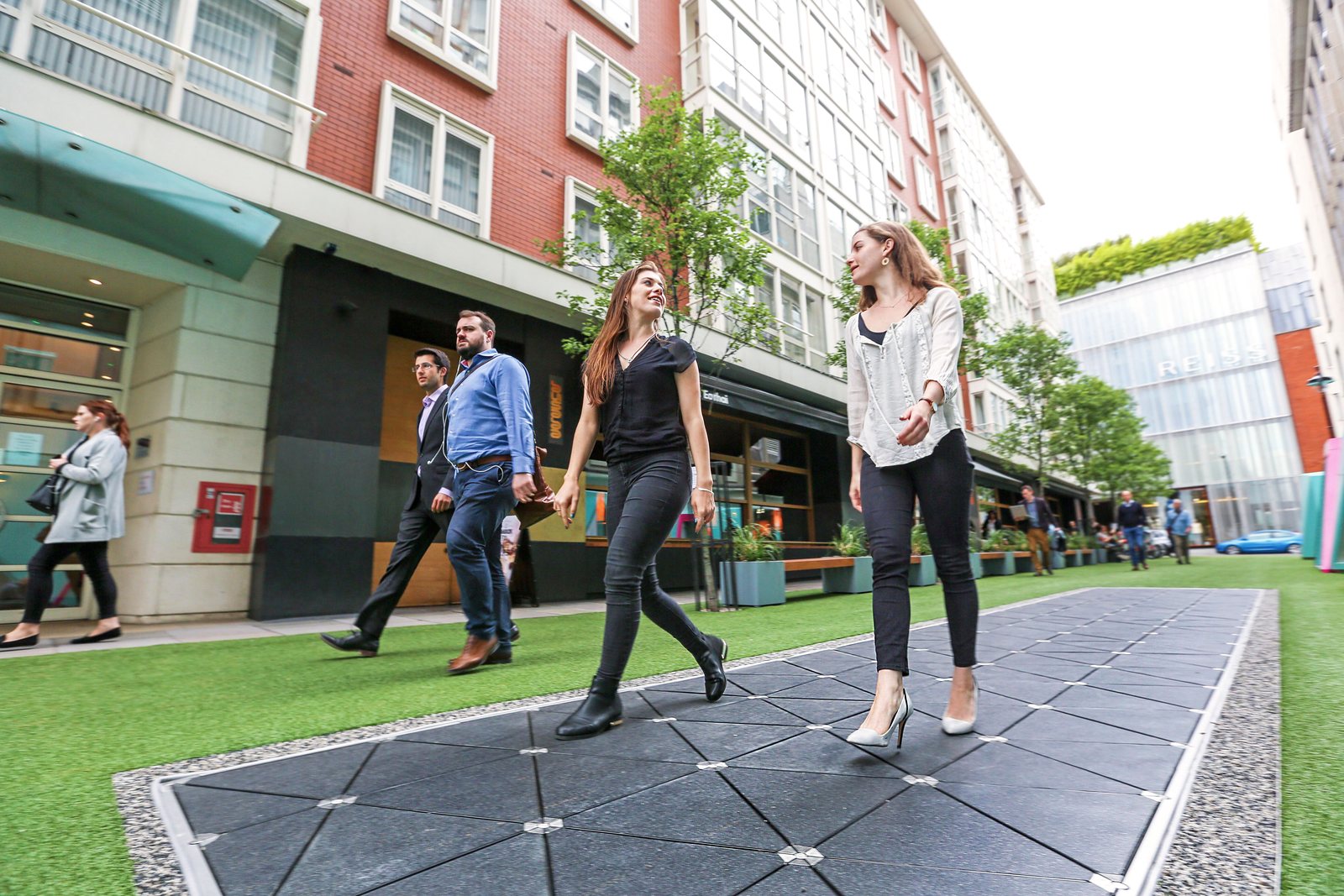
In his words, “they didn’t ask me was it illegal or not.” He guessed a six-figure price on the spot, and Westfield became Pavegen’s first customer in 2012. “The company was a one-year-old and had to become a teenager very quickly.”
Ninety-seven camera crews filmed the launch of a football pitch in a Rio favela, funded by Shell, with Pelé on stage. Then his phone rang. Pavegen was “technically insolvent”, and “the company would pretty much run off my credit card at that point.”
At the same time, they deployed at a stadium summit in Nice. The money ran out on the way. “I was sleeping on a pallet in the back of a van on the way there and I had my suit hanging up.”
During the first 10 years he was making about £10k a year, and 50% of the company is still his.
One idea since 2009, and over a billion steps on it.
So what does one footstep do inside the tile?
How does a Pavegen tile turn footsteps into electricity?
The thing he was driving to Nice to install is a floor tile. One average adult step sinks it 5-10 millimetres, and that movement comes back out as 3 to 5 joules of electricity.
If you’ve never bought a kinetic tile, here’s the chain from footstep to use:
1/ You step on the tile and it drops 5-10 millimetres.
2/ That downward push turns a flywheel.
3/ Magnets on the flywheel pass copper coils, and induction makes the current.
4/ AC becomes DC. Doing that “without losing half the power” was the hard part, he says, and “nothing worked off the shelf.”
5/ The power is used on the spot or stored in a battery.
6/ The same step sends data, and if you’ve opted in, a Bluetooth beacon can put a reward on your phone.
Why a flywheel and not piezoelectric crystals?
Because a piezo crystal gives a burst too short to use. In his words, piezo is “a dead technology when it comes to doing meaningful things.”
A flywheel keeps the energy moving. One step spins it for about five seconds, by his count, and the next walker’s step tops it up.
Why is the tile a triangle?
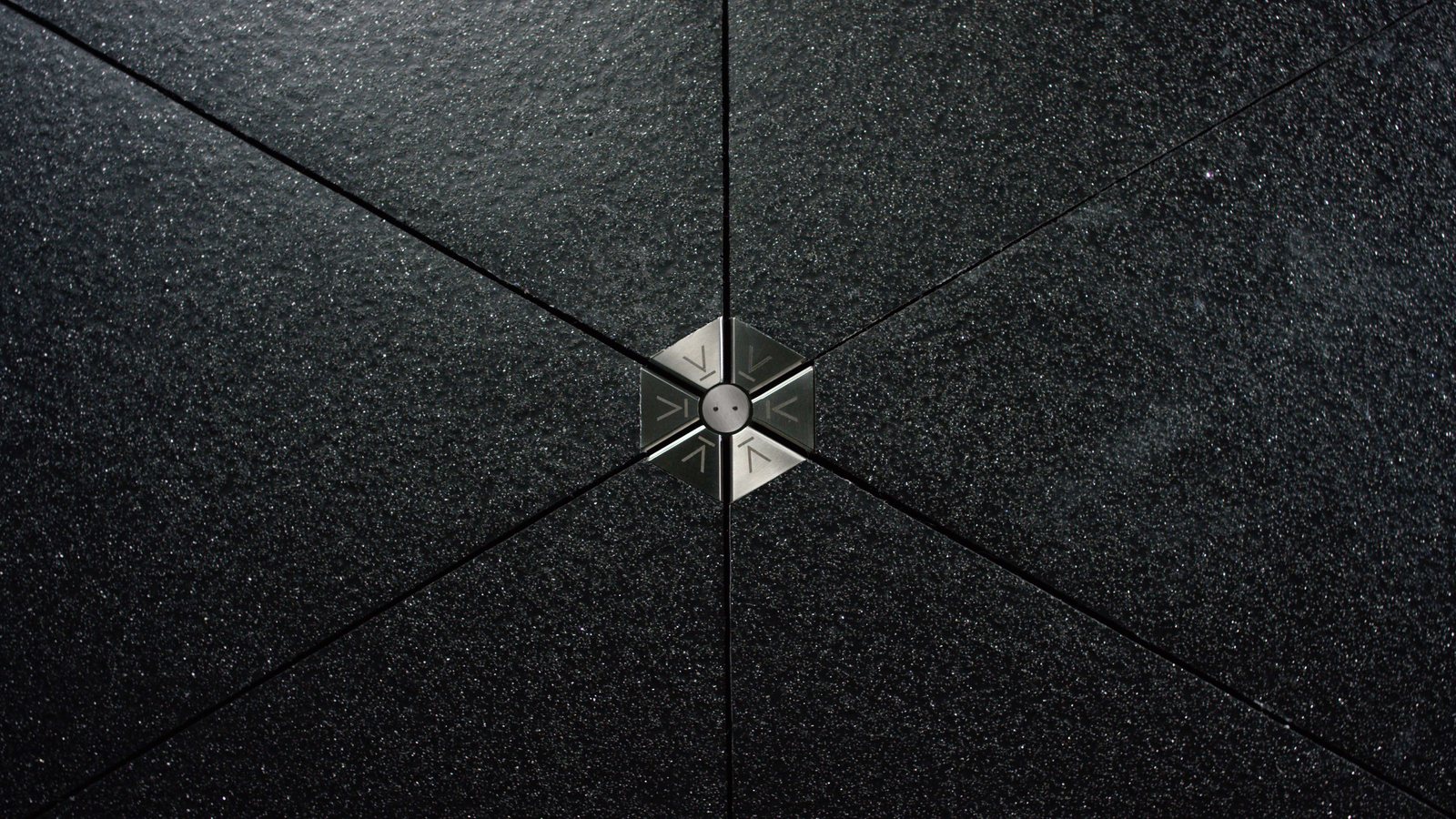
The first shape missed half the walkers. An early install at Heathrow was a rectangle with fixed corners, and in his words “we only captured maybe half the steps, because the rest were on the corners.”
A triangle mesh puts a moving corner under every step. Pavegen’s page on the V3 (their current tile) calls that “no dead zones”, and he calls it “200 times more efficient.”
Getting there took over 750 prototypes. It works from minus 30°C to 70°C, and the lightest walker who counts is a child of around 30 to 40 kilos, so “a dog wouldn’t generate power.”
How much electricity is that, honestly?
Enough for a light: one step powers a 5 W bulb for one second.
His comparison: two Olympic athletes cycling flat out for half an hour “only just power a toaster together”, under 20p of electricity.
He says it himself: “you’ll never power New York City from people alone.”
Where the tile makes sense is where you have high-density 24/7 traffic: a mall, subway, Shibuya Crossing.
His Oxford Street estimate, never installed: “you could power around 70 lights all night long, all the time, permanently from just 30 square meters.”
Where is Pavegen installed?
Right now, there are 250+ installations.
So far, Pavegen has:
→ Lit a pocket park south of Dupont Circle in Washington DC through the night, about 7 hours from roughly 10,000 walkers a day by his count
→ Built five walkways on Riyadh’s Sports Boulevard, a 135 km project, where the steps light LEDs in the handrails
→ Laid the first indoor exercise track that makes energy, at The Quayside in Hong Kong.
→ Wired Bird Street, off Oxford Street, so footsteps run the LED lighting and play birdsong
→ Reached 37 countries
→ Logged over a billion steps on its tiles

Another vertical of theirs is the rental business that started by accident. In his words: “we rented a Pavegen floor once and someone used it as a dance floor, we were like, sure, you can do that.”
For example, Trafalgar Square, 31 May 2024. Rudimental played the UEFA Champions Festival for Rockstar Energy in front of over 6,300 people, and the crowd’s dancing helped power the DJ booth and the mic.
If people didn’t dance, the music would turn off.

Some other rental examples:
- A Guinness St Patrick’s Day floor in Chicago
- A Google Pixel launch
- Kia’s tennis floor at the Australian Open.
Their other two revenue streams come from data and warranties.
But, as I was doing my research on Pavegen and Laurence himself, all of his interviews were 5+ years old. So I wanted to make sure I had the most up-to-date information and luckily, I got to talk to Laurence last week.
Where does Pavegen stand now? 5 questions with Laurence
Let’s just go straight into it.
Where’s the company at right now?
“We’re a team of around 25 people. ... I didn’t plan to do this, but we made energy fun. ... We’ll also work in the infrastructure space. We’ve recently included a deployment at one of the Saudi giga projects. As much as I love England, we’re not building big things here.”
“We’ve worked with Westfield Mall in Germany and several pop-ups in malls across the Middle East.”
Pavegen’s deployed in 37 countries since the first order in 2012.
What’s the one thing you’re most proud of?
“A small company like Pavegen taking on some of these big giga projects in Saudi Arabia shows that we can deliver in really, really tough environments. ... Doing million-dollar deals in that kind of scope of deal size is something I’m most proud of.”
What’s the biggest misconception people still have about Pavegen?
“People want to power their whole city from one human step. ... So you’re saying one step won’t power my whole building or my city? No. The quantum of power is obviously small. ... People don’t really understand energy.”
It sounds like a no-brainer. What’s the biggest challenge you see?
“The biggest challenge is raising investment, for an idea as big as Pavegen where it is a totally new category of technology, it takes really bold investors to support it. ... We work on some of the biggest construction projects in the world and these, as you can imagine, can take more than 12 months to close.”
“It’s one of the hardest technologies in the world to build because it’s got to be incredibly durable, really robust, take huge temperature fluctuations, and it’s got to be low cost. ... If it was $5 for a square meter, then it would be obviously everywhere. We are still in the early stages of our journey and the major cost reduction has not happened yet.”
Anything you’re building towards in the next 12 months? And who’s the ideal buyer or investor reading this?
“We’re trying to take over the world and sell the company to a huge infrastructure company that can take it to the next stage.”
I asked for anything specific.
“Not that I can report without getting sued”, he said jokingly.
“The key markets we work in are retail, transportation, smart cities, and education. ... We want investors who really support bold ideas to make a big difference to urban futures. One really good example is Thomas Heatherwick, a world-famous architect who talks a lot about ... making cities about people. ... You’ve got to put your number one asset first. And no, it’s not AI, and it’s not a data center. It’s me and you.”
Liked today’s piece?
I’m always on the lookout to interview exceptional climate tech founders actively making the world a better place. A lot of them are like Laurence, they make cool tech but stay relatively silent about it. I’m on the mission to fix it by making them as visible as possible through my content.
If you know who I should talk to next, feel free to reach out to me or connect us via email.
Till next time,
Roman
PS. This is exactly why I started my ghostwriting practice for climate tech founders. Featuring them in a single email or article is great, but it’s not scalable. Building their online visibility through thought leadership content, however, is far more powerful.
DM me if you want to see how we can take you from being invisible online to investable and impossible to ignore.
About the Author
Roman Pikalenko runs Kaizen, a solo studio that takes climate tech founders from invisible to investable. He’s ghostwritten 2,200+ posts for 14+ founders across 4 continents, among them 3 LinkedIn Top Voices and a Forbes 30 Under 30, whose companies have raised over $200M combined. Roman is an incoming self-published author; his first book, From Invisible to Investable, on the storytelling behind all of it, is expected Q4 2026.