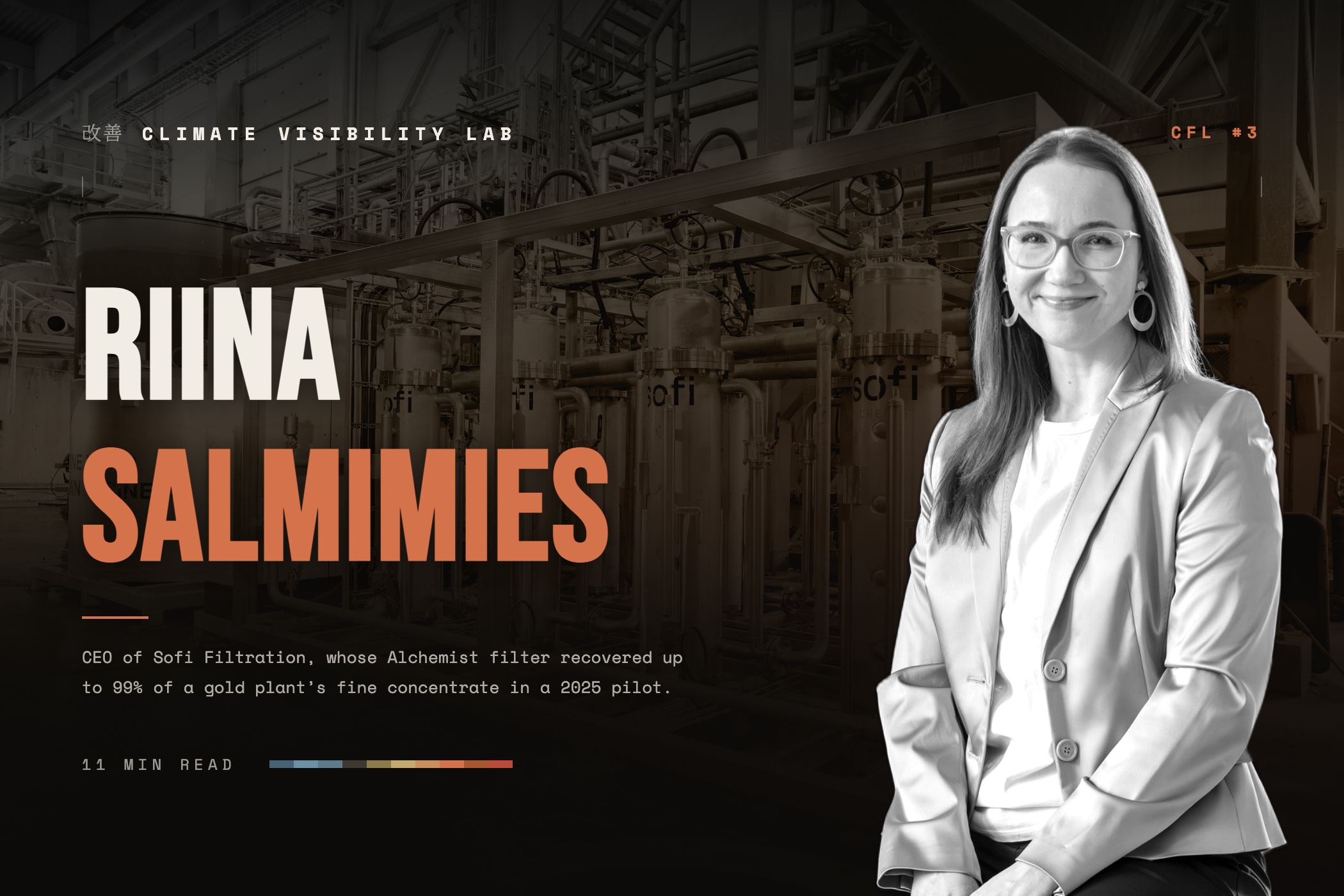
Welcome to the 3rd official edition of Climate Founder Letters, a newsletter version of what many of you might know as Climate Founder Mondays on my LinkedIn and a new sub-series under Climate Visibility Lab. If you’re not, CFMs have always had one purpose: highlight most influential yet underfeatured climate tech founders out there, specifically focusing on their stories over their tech. Everyone covers tech.
Today’s feature is Riina Salmimies, CEO of Sofi Filtration.
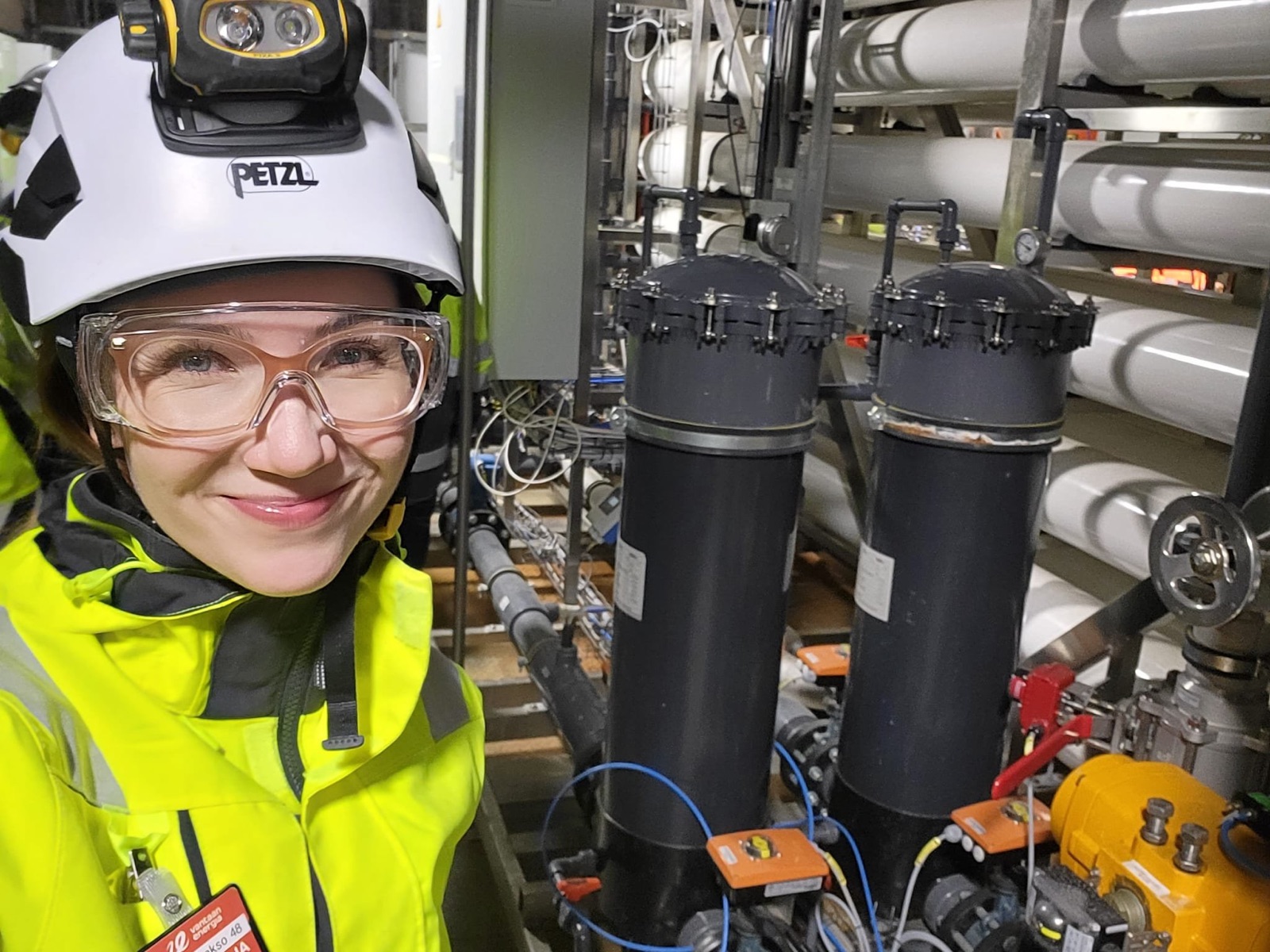
I’ve listened to every interview of hers, every breakdown and report on Sofi Filtration, and a bit of background that’s available online on Riina.
Riina has a doctorate in chemical engineering. She ran a university’s school of engineering. Then she took over a filter company that hadn’t found its market yet.
Here’s the odd part: the product now running at full scale in a gold plant was never planned. Someone on her team noticed something in the water.
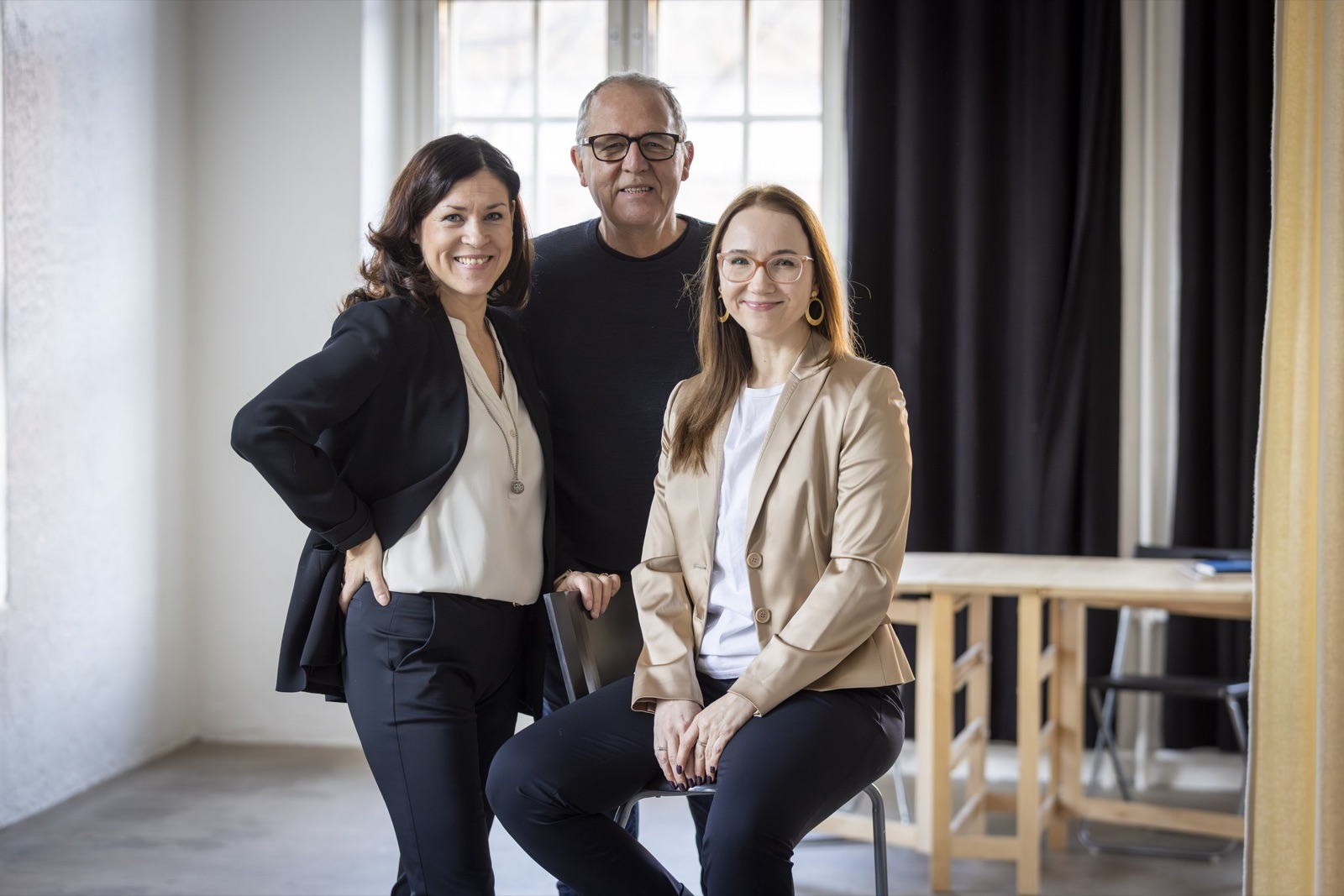
Sofi was founded by three engineers, on technology that came out of university research in Finland. Their first filter went to Anglo American’s Sakatti project in 2013. By the time Riina joined the company, the technology was well industrialized, but the product market fit was not quite there.
She joined the board in July 2022 and became CEO that October. She came from what she calls “an extensive academic background.”
“I’ve always wanted to see what the private sector is like,” she says. “When that door opened I figured, you know, this is now the time to go through that door. If I don’t, I’ll never do it.”
So, in this issue, we’ll cover:
→ What her team found in the process water
→ Why customers said it made no sense, and what changed their minds
→ What happened at Pampalo, and where Sofi stands now
Let’s get into it.
Riina’s team found something valuable in the process water, and nobody had planned it
Mining plants make their money from something called a mineral concentrate. “That is where you have the valuable metals,” Riina explained in her EIT Awards pitch in November 2025.
But in those processes, the finest particles slip into the water. According to Riina, up to 20% of these valuable metals are lost at a mineral processing plant.
Why do the usual steps lose them? Three reasons, from a 2025 review of fine-particle flotation in Minerals Engineering:
- Bubbles miss them. Flotation works by sticking mineral particles to air bubbles that carry them to the surface. Tiny, light particles rarely collide with a bubble and stick to it. The review puts the drop-off below 38 micrometres.
- They soak up the chemicals. Fine particles have a lot of surface for their weight. They use up the chemicals that make minerals float, and slime coats them.
- They settle too slowly. In a thickener, the water is supposed to clear while the solids sink. The finest particles stay suspended, so they leave with the water.
So plants often send them to the tailings pond. At one copper plant in Iran, the review notes, about a quarter of all copper losses were in particles smaller than 23 micrometres.
That water is where Sofi’s team found the opportunity.
“This was an accidental, you know, invention,” Riina said in a February 2026 interview with EIT RawMaterials. “It wasn’t something that was planned, but we just realized, okay, we have something in this water. Oh, we actually have quite a lot of it in this water. Oh, it’s quite expensive actually. So, can we do something with this?”
The answer became the Sofi Alchemist, launched in May 2025.
It runs on the same filter Sofi has been building since its first delivery in 2013, in four steps:
- Water goes in. Process water from the plant runs through a membrane made of layers of sintered metal.
- Solids stay on the membrane. The water passes through and can be reused.
- Ultrasound cleans the membrane. High-power ultrasound shakes the particles loose, helped by a pulse of water and compressed air at about 90 psi. No chemicals, and little work for operators.
- The Alchemist keeps the metal. It captures particles down to 0.3 micrometres, and that catch becomes extra mineral concentrate.
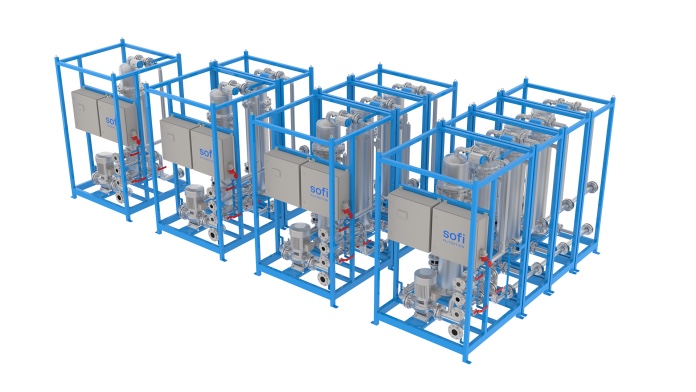
Riina says it can produce up to 20% more concentrate and clean processed water at the same time.
They started with gold. Next on their list are copper and nickel, two metals the energy transition runs on.
So they took the Alchemist to their customers.
The first answer was “yeah, no.”
Customers said the Alchemist made no sense until Riina’s team showed them the data
The finding went to customers as a question.
“There’s metal in your process water. Can we do something with it?”
The answer came back fast. The particles were too fine, and there were too few of them in the water, to be worth the effort. Recovering them made no techno-economic sense, as the customers put it to her.
So, Sofi came back with specifics.
In her February 2026 interview with EIT RawMaterials, Riina describes what it took to turn the ‘no’ into a ‘yes’.
- Condition 1: Showing them the data. Sofi measured what was in the water and what it was worth. The flat ‘no’ became a question: what is this stuff, really?
- Condition 2: Testing their own water. Once the numbers were on the table, customers asked whether Sofi could look at their process water too.
- Condition 3: Acknowledging the loss. A plant that saw its own numbers accepted two things. The metal was there, and it could be recovered.
This was backwards of how the startup textbook typically runs.
Usually, you validate the need first, then ask customers if they have the problem, then build.
“If we did that, the Alchemist would have never been born,” she said. “They would have told us no.”
One of those demonstrations ran at a gold plant in eastern Finland.
The Pampalo pilot recovered up to 99% of the fine concentrate, and since June 2026 the plant runs it at full scale
Pampalo is a gold mine in Ilomantsi, eastern Finland, run by Endomines. In 2025, Sofi set up the Alchemist on the plant’s process water for a pilot.
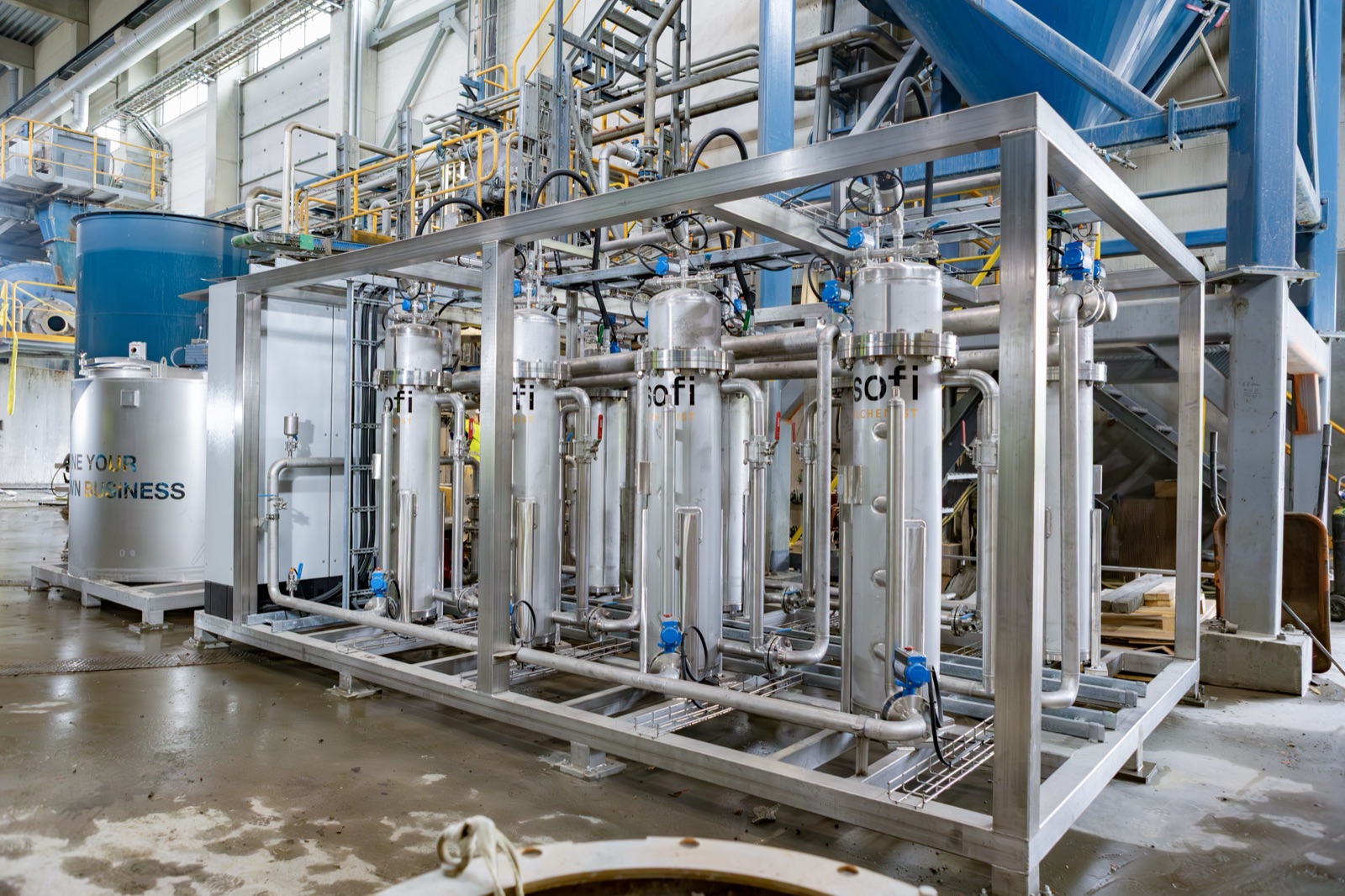
The results came out in September 2025. The Alchemist recovered up to 99% of the fine concentrate in the water, and about 98% on average.
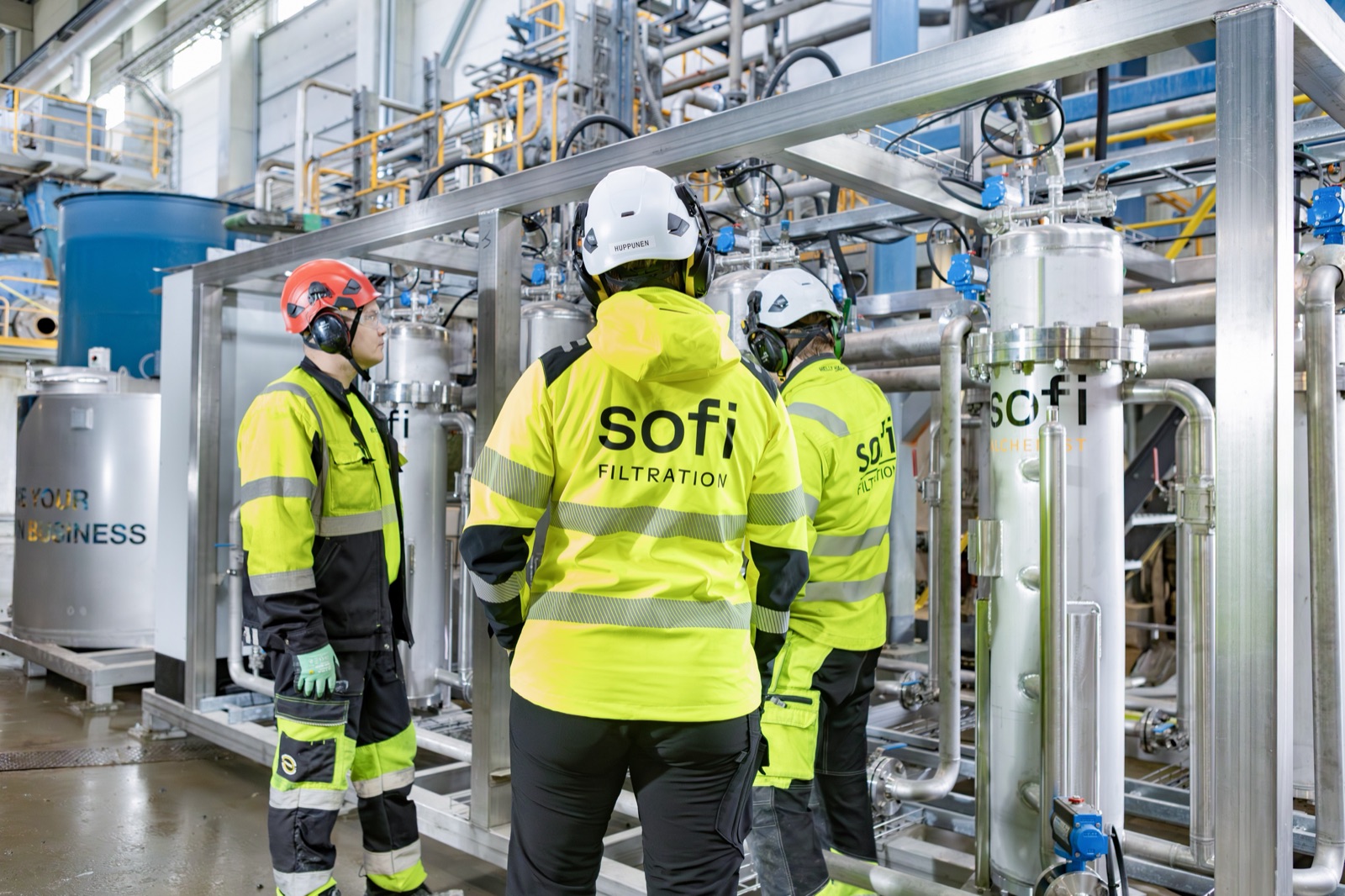
In June 2026, Endomines took it from the pilot to the full plant. Sofi now runs the Alchemist at Pampalo as a service. They call it Recovery as a Service.
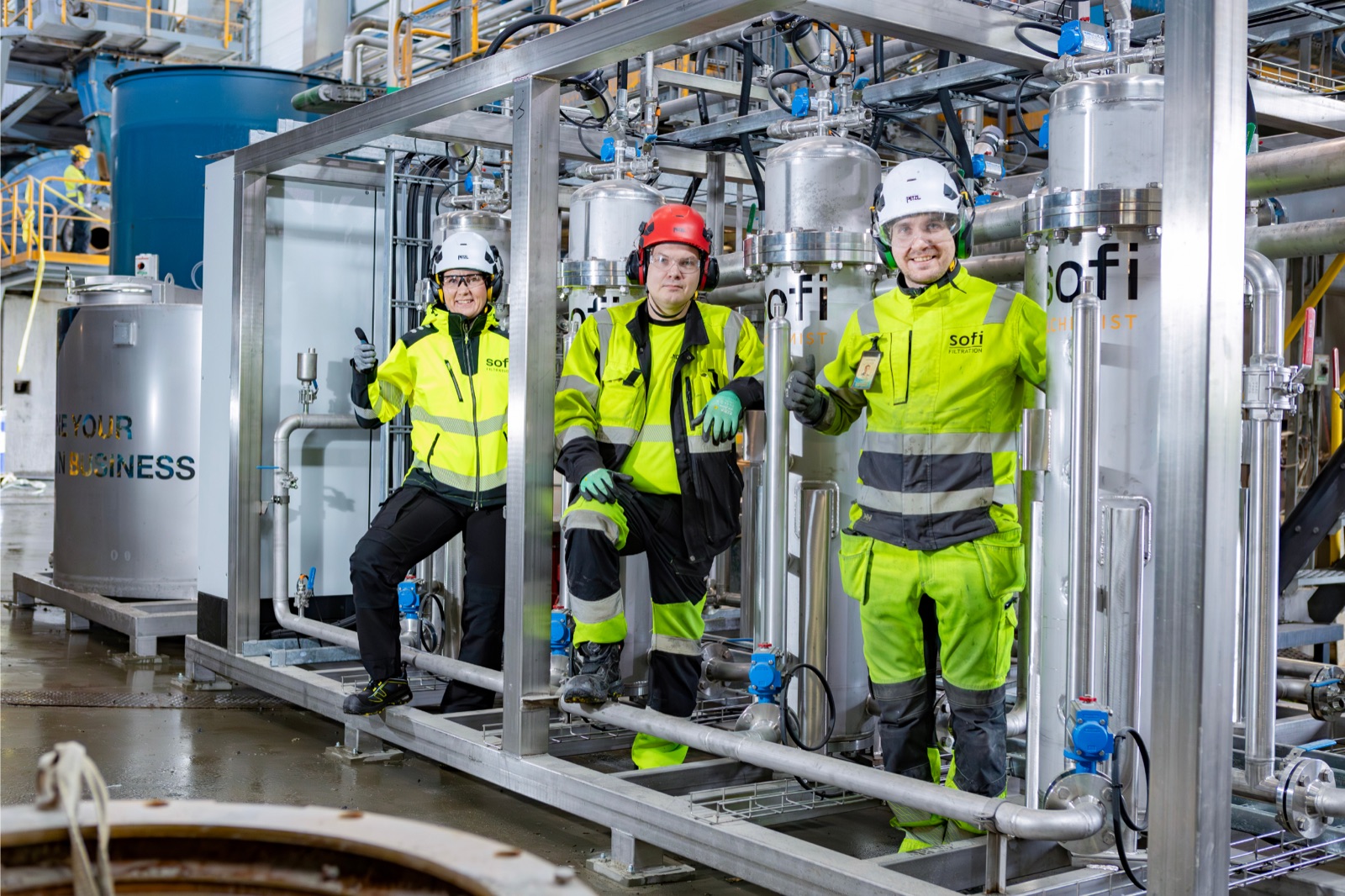
That word, service, is the other half of the Sofi story.
Sofi used to sell its filters outright. Now it builds the unit, owns it and operates it at the customer’s plant. That takes the upfront investment off the mine’s books. In her EIT Awards pitch, Riina put the model in one line:
“We don’t sell equipment. We sell value.”
Why would the service model be beneficial to a mine? Six reasons, in order of how often they come up:
- No upfront capital. The mine pays for what the unit does, not for the unit. The plant never goes on its balance sheet.
- The vendor shares the risk. If the unit underperforms, Sofi feels it first. In a plain equipment sale, the mine is left holding it.
- Both sides get paid on output. A service contract pays on what the unit recovers, so Sofi only earns when the mine does.
- Sofi runs it. Operating and maintaining the unit is Sofi’s job. The mine’s people stay on mining.
- New tech gets in faster. This one is Riina’s claim. The model is, in her words, “speeding adoption of new technology in an industry that is notoriously slow in adopting anything new.”
- Sofi gets recurring revenue. This one is for her investors. Her target is 80% of revenue recurring, which is the kind of number a Series A investor likes.
So, what does Sofi have to show for it so far?
Well, in the past year alone:
→ Second place in the Venture category at the EIT Innovation Awards 2025, with a €30,000 prize
→ €900,000 from EIT RawMaterials in 2025. The money pays for more industrial pilots and new countries
→ The Mineral Processing Excellence Award at the Mining Magazine Awards 2026, in September
→ A Sofi Prima system at Terrafame’s battery-chemicals plant in Sotkamo. It helps the plant make purer nickel sulphate, at lower cost and with less water
→ Revenue of €524,000 in 2025, up 870% on the year before. The figure comes from Asiakastieto, the Finnish company-data service
Gold is where the Alchemist proved itself. Copper and nickel are the next two targets, and in Europe that choice is about more than the price of metal.
3 specific reasons why they might be focusing on them next:
- Demand. The IEA expects global copper demand to grow by about 30% by 2040, and nickel demand to double. Nickel sulphate goes into batteries. Copper goes into almost everything else the energy transition is built from.
- Supply. The EU imports about three quarters of the refined nickel it uses, and in the Commission’s last count, 29% of it came from Russia. China refines a third of the world’s nickel and more than a third of its copper. That is why the EU now lists both metals as strategic raw materials, with a 2030 target of no more than 65% of any of them from one country.
- Recycling. The same EU law wants 25% of its strategic raw materials to come from recycling by 2030. Copper is already at 55%. Nickel is at 16%.
Recovering metal that a plant already dug up, from water it already has, counts towards that last number. A 2021 study of mineral losses puts the loss to tailings at 25 to 30% for some critical metals, copper among them.
As of her December 2025 pitch, Sofi was raising a €5 million Series A to grow its service fleet and expand internationally. No closing announcement was out when this piece was written.
In a February 2026 LinkedIn post about Nordic mining, Riina wrote that the industry doesn’t lack marketing or storytelling. What it lacks, in her words, is “ambition and growth capital.”
And I get where she’s coming from.
There’s a severe lack of funds for novel tech in the EU. We’re more risk averse than Americans. And generally, things take longer to approve and push through the legislation and permits.
But that’s exactly why storytelling is crucial.
It’s what keeps your climate business top of mind for buyers, hires, legislators, or whoever needs to know about you and your company.
And more importantly it’s what builds trust. And without it, it’s hard to convince anyone to invest millions of euros into something they might understand but not believe in.
Liked today’s piece?
I’m always on the lookout to interview exceptional climate tech founders actively making the world a better place. A lot of them are like Riina, who told me she hadn’t done many interviews. I’m on a mission to fix that, by making them as visible as the work deserves.
If you know who I should talk to next, feel free to reach out or connect us via email.
Till next time,
Roman
PS. This is exactly why I started my ghostwriting practice for climate tech founders. Featuring them in a single email or article is great, but it’s not scalable. Building their online visibility through thought leadership content, however, is far more powerful.
DM me if you want to see how we can take you from being invisible online to investable and impossible to ignore.
About the Author
Roman Pikalenko runs Kaizen, a solo studio that takes climate tech founders from invisible to investable. He’s ghostwritten 2,200+ posts for 14+ founders across 4 continents, among them 3 LinkedIn Top Voices and a Forbes 30 Under 30, whose companies have raised over $200M combined. His first book, From Invisible to Investable, on the storytelling behind all of it, is out now.